Stats
Actions
Available In
Tags

Govern AI agent workflows with graph-first governance, backlog tracking, and runtime observability. Add gate checks, duplicate detection, evidence collection, and dashboard-based audit to Claude Code sessions.
Guided operator for the Aming Claw HN multi-agent challenge demo. Use when a user asks to run, preview, present, or collect evidence for the HN demo showing one observer coordinating multiple commit-bound workers, failed/interrupted worker replay, graph traces, reconcile, and audit self-review.
Public demo for Backlog Duplicate: a new requirement overlaps existing backlog work, and the observer asks whether to merge, supersede, or keep it separate. Use when a user asks to run, preview, or collect duplicate backlog evidence with the current Claude Code or Codex observer session.
Public demo for Docs Drift: a feature changes but documentation is stale, and the drift state is surfaced before a second doc fix. Use when a user asks to run, preview, or collect evidence for docs drift with the current Claude Code or Codex observer session.
Public HN challenge entrypoint for Aming Claw. Use when a user asks to run, preview, present, or collect evidence for the multi-agent challenge: one observer coordinates multiple commit-bound workers, records a failed or interrupted worker, replays it from the same contract lineage, reconciles the target graph, and writes an audit self-review.
HN demo case for the fear that code changes leave docs, tests, and config stale after implementation. Guides evidence collection for Asset Inbox, binding state, Baseline and Possible drift, Review Queue, impact scope, and review boundaries.
Own this plugin?
Verify ownership to unlock analytics, metadata editing, and a verified badge. GitHub access is read-only (username + org membership).
Sign in to claimOwn this plugin?
Verify ownership to unlock analytics, metadata editing, and a verified badge. GitHub access is read-only (username + org membership).
Sign in to claimBased on adoption, maintenance, documentation, and repository signals. Not a security audit or endorsement.
Your AI agent and you, sharing the same dashboard.
Open source workspace for AI-coded development. See what AI is touching in real-time, audit every change, review proposals before they land in your codebase. Multi-language (Python/TypeScript), MCP-native, local-first.
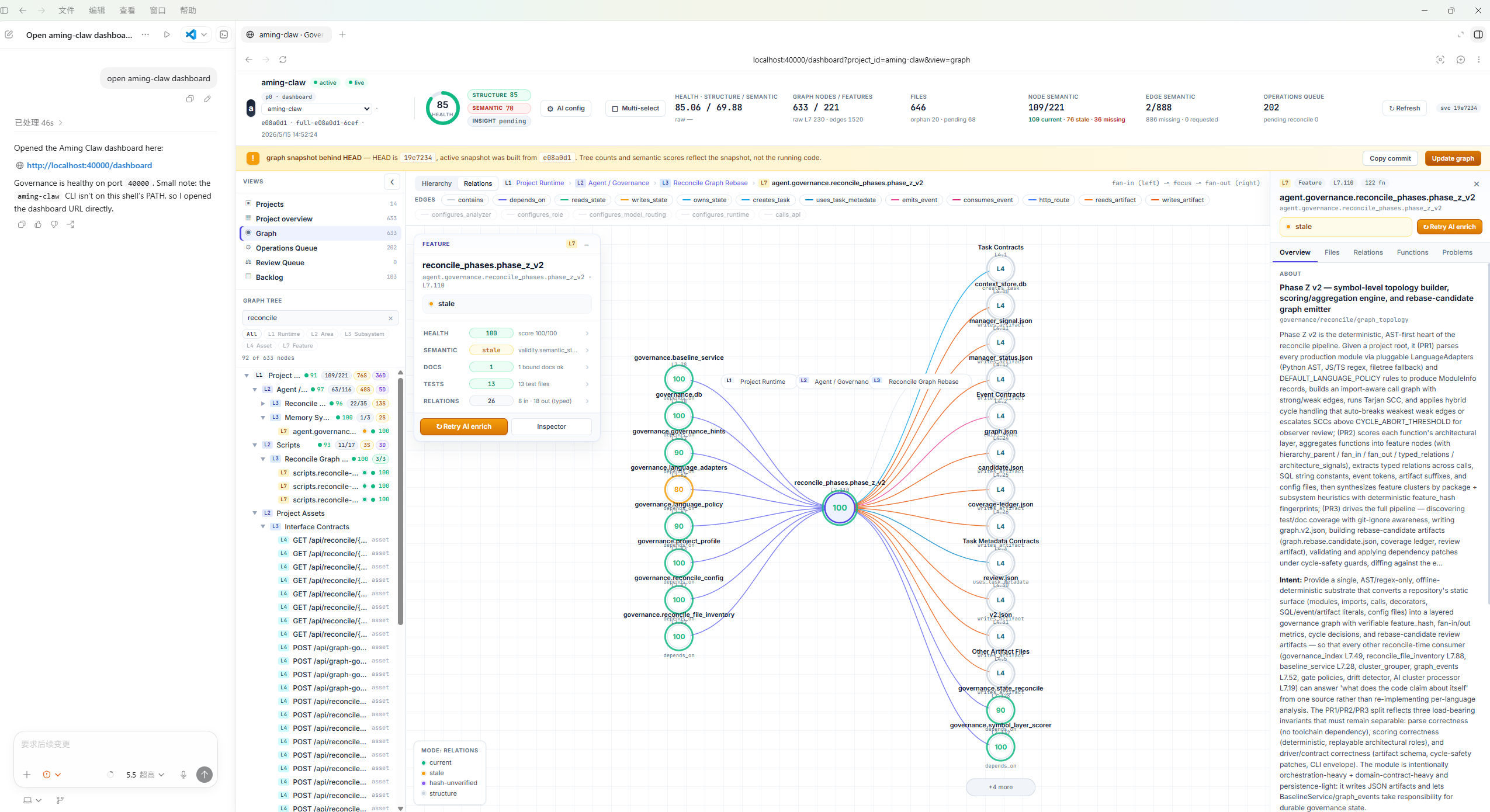
Aming Claw is a graph-governed control plane for AI-agent code review. The claim is narrow: not total program correctness, not human-free review, and not free first-build cost on huge monorepos. The V1 loop is a reusable project fact layer: commit-bound graph state, typed AI proposals, review gates, durable repair rules, and reconcile after code or rules change.
flowchart TD
  Human["Human reviewer"] --> UI["Dashboard"]
  Agent["AI agent"] --> MCP["MCP tools"]

  UI --> Gov["Governance control plane"]
  MCP --> Gov

  Gov --> Backlog["Backlog<br/>intent + work ledger"]
  Gov --> Review["Review Queue<br/>accept / reject proposals"]
  Gov --> Graph["Commit-bound graph<br/>files, functions, tests, docs, config"]

  Agent --> Proposal["Typed AI proposals<br/>semantic / graph / config / backlog"]
  Proposal --> Review

  Code["Committed code"] --> Reconcile["Reconcile<br/>derive review state"]
  Rules["Hints + config + rules"] --> Reconcile
  Review --> Events["Accepted semantic events"]
  Events --> Reconcile

  Reconcile --> Graph
  Reconcile --> Semantics["Semantic projection<br/>current / stale / missing"]

  Graph --> Context["Scoped review context"]
  Semantics --> Context
  Backlog --> Context
The important boundary: AI proposals are not trusted state. Committed code, source-controlled hints/config/rules, and accepted semantic events are source; graph snapshots, semantic projections, review queues, and test/doc/config bindings are derived state.
Start with the AI host you use. The longer requirements, raw installer commands, and troubleshooting notes are in Install Details.
Ask Codex for the complete one-shot path. This installs the plugin/runtime, starts local governance, and opens the dashboard:
One-shot install and open dashboard for Aming Claw from https://github.com/amingclawdev/aming-claw
If you only want to refresh the local plugin package, use the install-only command instead. Install-only does not start the long-running governance service and does not open the dashboard:
aming-claw plugin install https://github.com/amingclawdev/aming-claw
Reload Codex or open a new Codex session after install. First-run startup and verification steps are in Install Details.
Paste this once — Claude bootstraps the plugin end-to-end:
Install aming-claw end-to-end from https://github.com/amingclawdev/aming-claw:
1. Run `/plugin marketplace add https://github.com/amingclawdev/aming-claw`
2. Run `/plugin install aming-claw@aming-claw-local`
3. pip install -e the marketplace clone at
   ~/.claude/plugins/marketplaces/aming-claw-local
   (Windows: %USERPROFILE%\.claude\plugins\marketplaces\aming-claw-local)
4. Start `aming-claw start` in a background terminal
5. Run `aming-claw open` to launch the dashboard
6. Remind me to reload Claude Code so the plugin's MCP tools and skills load
Steps 1–2 only copy the skill files; pip install adds the Python runtime,
aming-claw start boots the local governance service, and aming-claw open
launches the dashboard. After reloading, phrases like "install and start
aming-claw" or "one-shot install" trigger the launcher skill's one-shot
mode for re-bootstrap in future sessions. First-run troubleshooting and
raw installer scripts are in Install Details. The compact
onboarding state machine is /aming-claw:aming-claw-launcher; the full
first-run schema and route-gate notes are in
docs/onboarding.md.
npx claudepluginhub amingclawdev/aming-claw --plugin aming-clawComplete project development toolkit: 23 agents, 23 slash commands, 29 lifecycle hooks, and 69 reusable skills for Claude Code workflows
 rjmurillo
Agent Teams orchestration, governance hooks, multi-AI review, memento skill intelligence, and project management skills for Claude Code
 insightflo
High-intelligence Claude Code copilot with deep code reasoning, evidence-driven planning, orchestration-first execution, model routing, context budgeting, CI/CD integration, enterprise security, plugin development, prompt engineering, performance profiling, agent teams, channels (event-driven autonomy with CI webhook, mobile approval relay, Discord bridge, and fakechat dev profile), interactive tutorials, LSP integration, security-hardened hook script library, MCP Prompts coverage, common workflow packs, runtime selection guide, computer-use patterns, checkpointing, scheduled-task blueprints, repo bootstrap scanner, hook policy engine (8 installable packs), layered memory deployment, role-based subagent packs (implementer, debugger, migration-lead, dependency-auditor, release-coordinator), 5 agent-team topology kits, autonomy operating mode (4 profiles + 3 gates), and a queryable 15-tool MCP documentation server with autonomy advisor.
 markus41
Agent enforcement framework — context injection, planning gates, session learning
 markmdev
Harness for Claude Code — skills, /harness:* slash commands, persona subagents, lifecycle hooks, and MCP tools without per-repo `harness setup`. Sibling plugins exist for Cursor, Gemini CLI, and Codex.
 Intense-Visions
Human-AI partnership for Claude Code. Share a terminal, orchestrate workers, evolve together. Brainstorm ideas, turn them into wishes, execute with /work, validate with /review, and ship as one team.
 automagik-dev
'%20stop-opacity%3D'0.16'%2F%3E%3Cstop%20offset%3D'1'%20stop-color%3D'rgb(200%2C90%2C60)'%20stop-opacity%3D'0.03'%2F%3E%3C%2FlinearGradient%3E%3C%2Fdefs%3E%3Crect%20width%3D'320'%20height%3D'200'%20fill%3D'url(%23g)'%2F%3E%3Ccircle%20cx%3D'250'%20cy%3D'56'%20r%3D'92'%20fill%3D'rgb(200%2C90%2C60)'%20fill-opacity%3D'0.06'%2F%3E%3Ccircle%20cx%3D'64'%20cy%3D'172'%20r%3D'58'%20fill%3D'rgb(200%2C90%2C60)'%20fill-opacity%3D'0.05'%2F%3E%3C%2Fsvg%3E)