Stats
Actions
Available In
Tags

Orchestrate medical research projects end-to-end: intake and scaffold manuscripts, run systematic reviews and meta-analyses, audit citations and reporting guideline compliance, generate publication-ready figures and statistical code, de-identify clinical data, and produce IRB protocols, peer reviews, and journal submission packages.
Check manuscript compliance with medical research reporting guidelines. Supports 36 guidelines including STROBE, CONSORT, CONSORT-AI, STARD, STARD-AI, TRIPOD, TRIPOD+AI, TRIPOD-LLM, ARRIVE, PRISMA, PRISMA-DTA, PRISMA-P, CARE, SPIRIT, SPIRIT-AI, CLAIM, DECIDE-AI, MI-CLEAR-LLM, SQUIRE 2.0, CLEAR, MOOSE, GRRAS, SWiM, AMSTAR 2, and risk of bias tools (QUADAS-2, QUADAS-C, RoB 2, ROBINS-I, ROBINS-E, ROBIS, ROB-ME, PROBAST, PROBAST+AI, NOS, COSMIN, RoB NMA). Generates item-by-item assessment with PRESENT/MISSING/PARTIAL status.
Interactive data profiling and cleaning assistant for medical research. Three-stage workflow (profile, flag, code-generate) with user approval gates at each step. Handles missing values, outliers, duplicates, and type mismatches in CSV/Excel clinical data. Does NOT auto-clean — all decisions require researcher confirmation.
End-to-end cross-national comparison study using KNHANES + NHANES + CHNS (or other parallel surveys). Variable harmonization, parallel weighted analysis, and comparison tables. Supports 2-country (KR+US) and 3-country (KR+US+CN) designs.
Literature-grounded variable operationalization for observational research. Turns a data dictionary + research question into a citation-backed table of exposure/outcome/covariate definitions, cutoffs, and DB variable mappings. Prevents ad-hoc phenotype definitions that invite reviewer rejection. Bridges /search-lit output into /write-protocol Methods.
De-identify clinical research data before LLM-assisted analysis. Standalone Python CLI detects PHI via regex + heuristics with 10 country locale packs (kr, us, jp, cn, de, uk, fr, ca, au, in). Interactive terminal review. No LLM touches raw data — the script runs locally without any network or AI calls.
Own this plugin?
Verify ownership to unlock analytics, metadata editing, and a verified badge. GitHub access is read-only (username + org membership).
Sign in to claimOwn this plugin?
Verify ownership to unlock analytics, metadata editing, and a verified badge. GitHub access is read-only (username + org membership).
Sign in to claimBased on adoption, maintenance, documentation, and repository signals. Not a security audit or endorsement.
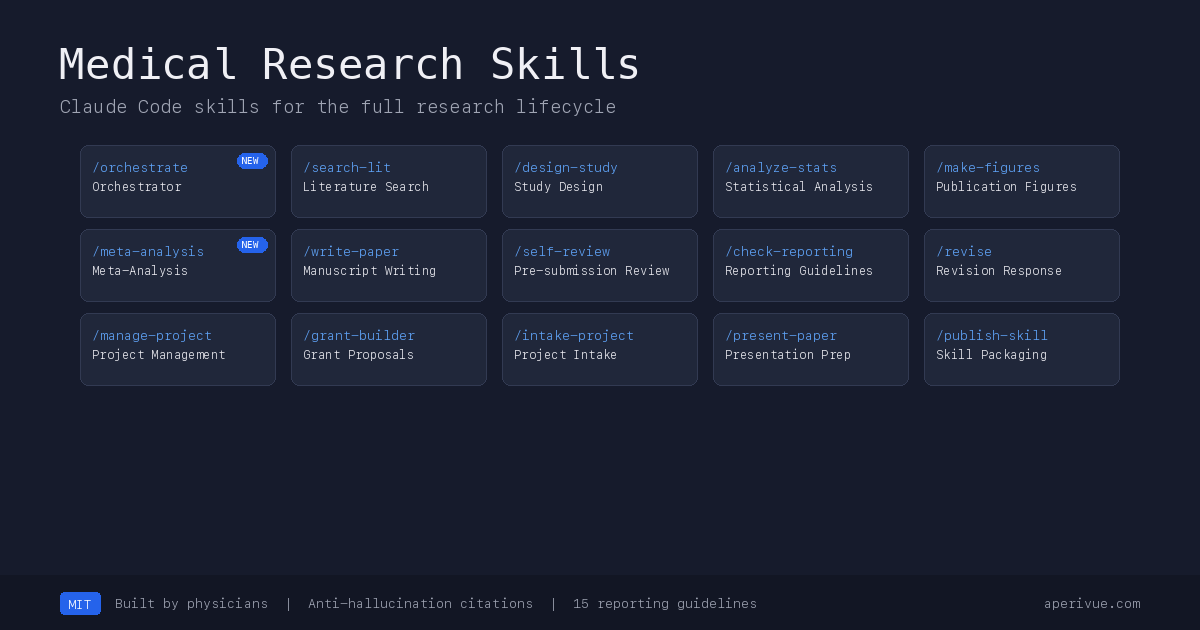
45 skills that actually work. Built by a physician-researcher, tested on real publications.
MedSci Skills is a submission-grade clinical manuscript workflow, not a generic biomedical skill catalog. Its moat is the compliance layer — 36 reporting guidelines and risk-of-bias tools, reference/citation verification, and deterministic integrity gates, before peer review sees the manuscript. It competes on clinical submission reliability, not skill count.









Topic Discovery → Literature Search → Full-Text Retrieval → Study Design → Sample Size → Protocol → De-identification → Data Cleaning → Statistics → Figures → Writing → Humanize → Compliance → Journal Selection → Peer Review → Revision → Presentation
Created & maintained by Yoojin Nam, MD
Department of Radiology and Research Institute of Radiology, University of Ulsan College of Medicine, Asan Medical Center, Seoul, Republic of Korea

MedSci Skills is an open-source Claude Code skill collection for clinical manuscript preparation. It helps physician-researchers and biomedical investigators move from literature search, study design, statistics, and figures to reporting-guideline compliance, citation/reference auditing, numerical-consistency checks, and response-to-reviewer workflows — combining agentic writing with deterministic integrity gates for submission-grade biomedical research. It is not a diagnostic tool, an autonomous author, or a general AI-scientist platform; every output requires human-expert verification. New here? See the 3 workflows below, the FAQ, and the scope boundary.
No terminal? Use the classroom installer ZIP — download, unzip, double-click the installer, then restart your agent app (see Installation).
Have a terminal? Fastest path — one command, nothing to clone:
npx medsci-skills install # copies every skill into your agent's folder
Have git? Install every skill in three commands:
git clone https://github.com/Aperivue/medsci-skills.git
mkdir -p ~/.claude/skills
cp -r medsci-skills/skills/* ~/.claude/skills/
Restart Claude Code, then start with /orchestrate — it classifies your request and routes you to the right skill. Full install options (Codex, Cursor, individual skills) are in Installation.
Prefer plugins? One line adds the marketplace; /plugin then lets you browse eight category plugins and enable the ones you want:
npx claudepluginhub aperivue/medsci-skills --plugin medsci-presentationAgent skill stack for submitting clinical research to JAMA (Journal of the American Medical Association), one of the big-four general medical journals. Covers scope fit and general-medical importance, study design, EQUATOR reporting standards (CONSORT / STROBE / PRISMA / STARD), statistical rigor with effect sizes and 95% CIs, the JAMA structured abstract and Key Points box, trial registration and ICMJE ethics/disclosure requirements, figures and tables, house style, cover letters, submission preflight, and peer-review revision. Bilingual en / zh-CN docs.
 brycewang-stanford
Production-grade academic research pipeline for Claude Code: research → write → review → revise → finalize. 4 skills, 27 modes, 39-agent ensemble, v3.7.3 + v3.8 L3 claim-faithfulness gate, v3.9.0 cross-index triangulation, v3.10 triangulation policy layer, v3.11 deterministic citation verification gate (#182).
 Imbad0202
Academic manuscript toolkit: peer review, manuscript writing, and journal-specific formatting for submission
 neuromechanist
PhD-level research capabilities: literature review, multi-source investigation, critical analysis, hypothesis-driven exploration, quantitative/qualitative methods, and lateral thinking
 poemswe
Multi-agent orchestrator for academic writing: 12 specialist agents and 30 writing principles for review, research, drafting, polishing, bibliography auditing, and literature surveys.
 andrehuang
Scientific writing, citations, grants, posters, and academic career (13 skills)
 AlterLab-IEU
'%20stop-opacity%3D'0.16'%2F%3E%3Cstop%20offset%3D'1'%20stop-color%3D'rgb(200%2C90%2C60)'%20stop-opacity%3D'0.03'%2F%3E%3C%2FlinearGradient%3E%3C%2Fdefs%3E%3Crect%20width%3D'320'%20height%3D'200'%20fill%3D'url(%23g)'%2F%3E%3Ccircle%20cx%3D'250'%20cy%3D'56'%20r%3D'92'%20fill%3D'rgb(200%2C90%2C60)'%20fill-opacity%3D'0.06'%2F%3E%3Ccircle%20cx%3D'64'%20cy%3D'172'%20r%3D'58'%20fill%3D'rgb(200%2C90%2C60)'%20fill-opacity%3D'0.05'%2F%3E%3C%2Fsvg%3E)


