Stats
Actions
Available In
Tags

Orchestrate AI coding agents through a structured RPI (Research-Plan-Implement-Validate) lifecycle with persistent knowledge flywheel, git-backed task graphs, multi-agent coordination, and automated validation gates for quality, security, and drift detection.
Expert code review specialist. Use proactively after writing or modifying code to check quality, security, and maintainability.
Deep codebase exploration and analysis. Use for understanding code architecture, finding patterns, and gathering context before making changes.
Switch coding-agent accounts on a usage/rate limit or to spread swarm lanes. Routes by host+agent: macOS+Claude via claude-acct; Codex/Gemini and Linux/WSL via caam. Triggers: "account-rotation", "account rotation", "switch coding-agent accounts on a".
The operator skill for the ACFS substrate. `~/acfs/bin/acfs` is a **fork-and-own provisioner** (idempotent, additive, cross-platform Mac + Ubuntu/WSL) over Dicklesworthstone's flywheel tools. This skill teaches you to check the substrate's health, wire it, and run the operating loop on top of it.
Use when coordinating agents with Agent Mail locks, inboxes, threads, and conflict-prevention handoffs. Triggers: "agent-mail", "agent mail", "use when coordinating agents with".
Make an out-of-session agent AgentOps-native with skills, the ao CLI, local cockpit proof, and CI backstop telemetry instead of runtime hooks. Triggers: "agent-native", "agent native", "make an out-of-session agent agentops-native".
Run AGY headlessly via scheduled ticks or `agy -p`, capture agentapi JSONL evidence, and validate automated AGY loops or event streams.
Uses power tools
Uses Bash, Write, or Edit tools
Own this plugin?
Verify ownership to unlock analytics, metadata editing, and a verified badge. GitHub access is read-only (username + org membership).
Sign in to claimOwn this plugin?
Verify ownership to unlock analytics, metadata editing, and a verified badge. GitHub access is read-only (username + org membership).
Sign in to claimnpx claudepluginhub boshu2/agentops --plugin agentopsBased on adoption, maintenance, documentation, and repository signals. Not a security audit or endorsement.
Coding agents can produce plausible code that is still wrong. AgentOps helps answer the two questions that decide whether you can trust the work: is the code right, and is the agent output proven enough to grant more autonomy? It sits on top of the agent you already use (Claude Code, Codex, Cursor, OpenCode) and adds the validation membrane, evidence trail, and repo-local corpus that make that judgment repeatable.
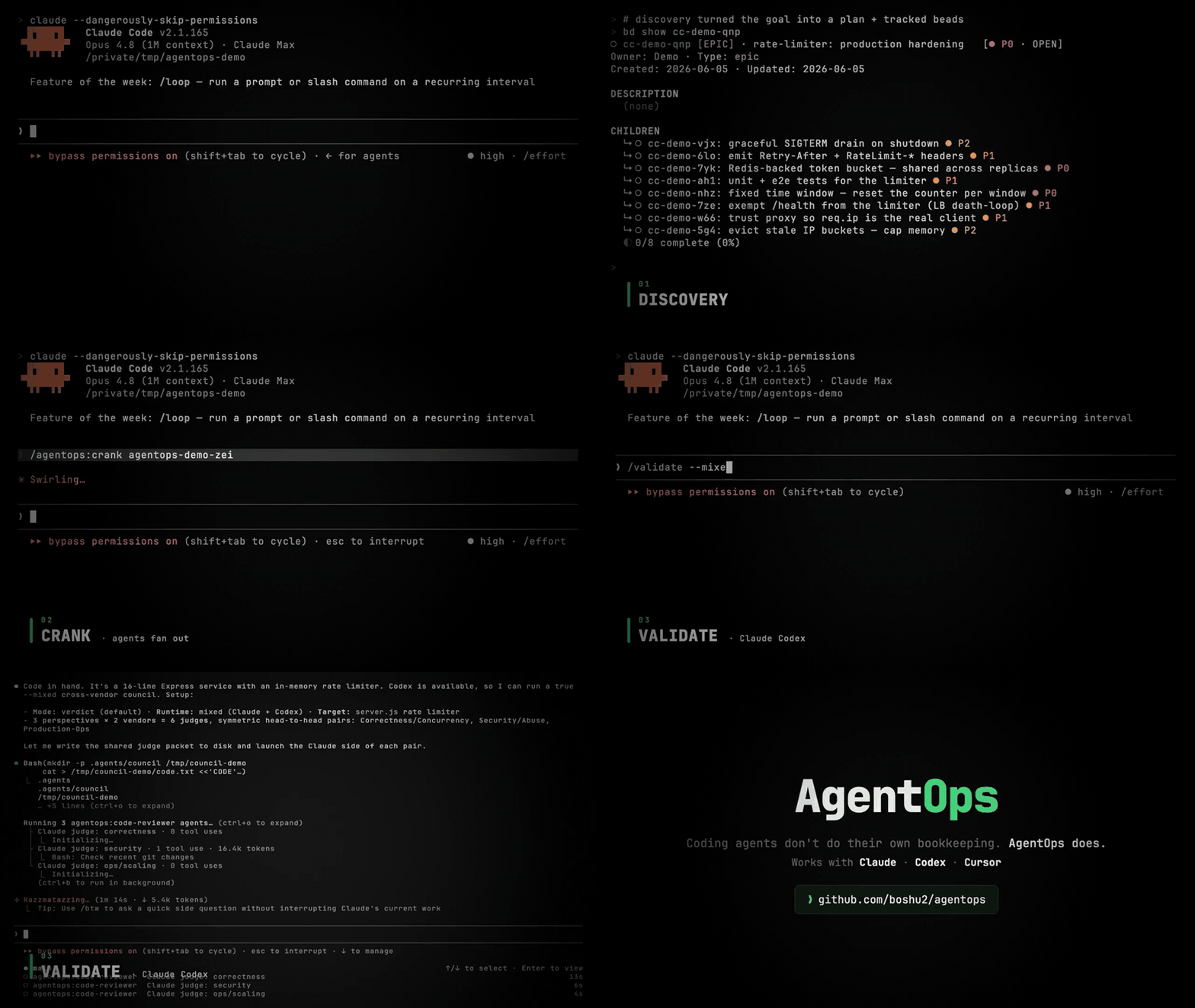
/discovery → bead graph · /crank → sub-agents in waves · /validate --mixed → real Claude + Codex verdict. Live sessions. MP4
AgentOps breaks intent into bounded slices, gives each a failing test and a write scope, and makes every phase boundary a gate that records evidence. The agent starts loaded with prior decisions and learnings instead of cold:
> /council --mixed validate this PR

[council] evidence sealed → 6 judges across Claude Code + Codex CLI
[claude/judge-1] WARN  rate limiting missing on /login
[codex/judge-1]  WARN  token bucket lacks jitter under burst
[claude/judge-2] PASS  redis integration follows pattern
Consensus: WARN, fix /login limit + refill jitter before shipping
Recorded → .agents/council/<run-id>/verdict.md
The center is validation: prove the agent output, keep the proof, and use that record to decide how much autonomy the next run earns. The supporting layers all stay local in .agents/ (no telemetry, no hosted control plane):
| Layer | The problem | What AgentOps adds |
|---|---|---|
| Validation membrane | agent output can look correct while being wrong | tests, local gates, /pre-mortem, /vibe, /council, and pawl verdicts prove or reject the work |
| Evidence trail | "looks good" does not survive handoff | .agents/ captures runs, decisions, findings, citations, verdicts, retros, and closeout proof |
| Context compiler | validators and implementers start cold | ao context assemble builds phase-scoped packets; ao lookup retrieves decay-ranked knowledge |
| Knowledge ratchet | lessons vanish between sessions | /forge mines learnings, /evolve reconciles, and durable lessons become constraints before more autonomy is granted |
The corpus is an LLM wiki of markdown. Agents read it natively and write to it as they work, so it maintains itself instead of becoming another doc you keep up by hand. Public citations of measurable flywheel or corpus outcomes use promoted artifacts under docs/evidence/ (e.g. 2026-04-02 flywheel case study); .agents/ remains the local operating substrate. Why that beats Notion or Confluence: docs/wiki-for-agents.md. The full theory (context as the lifecycle, the CDLC): docs/cdlc.md.
Pick your runtime, then type /quickstart in the agent.
# Claude Code
claude plugin marketplace add boshu2/agentops
claude plugin install agentops@agentops-marketplace

# Codex CLI (macOS/Linux/WSL).  OpenCode: install-opencode.sh
curl -fsSL https://raw.githubusercontent.com/boshu2/agentops/main/scripts/install-codex.sh | bash
# Codex CLI (Windows):
irm https://raw.githubusercontent.com/boshu2/agentops/main/scripts/install-codex.ps1 | iex

# Gemini / Antigravity
curl -fsSL https://raw.githubusercontent.com/boshu2/agentops/main/scripts/install-agy.sh | bash

# Other skills-compatible agents
npx skills@latest add boshu2/agentops --cursor -g
The ao CLI is optional but recommended (bookkeeping, retrieval, health, the loops):
brew tap boshu2/agentops https://github.com/boshu2/homebrew-agentops && brew install agentops   # macOS
# Windows: irm https://raw.githubusercontent.com/boshu2/agentops/main/scripts/install-ao.ps1 | iex
# Or release binaries / build from source (cli/README.md).
Installs hookless: skills and the ao CLI guide the workflow, and the local cockpit gate is the release authority. GitHub Actions are an optional/manual backstop, not the routine shipping path. The only hard requirement is an agent runtime and git; everything else degrades gracefully. Full dependency matrix: docs/dependencies.md. Day-2 install, update, backup, permission, recovery, and escalation paths are in docs/install-day2-ops.md.
Claude Code learns from itself. KERNEL gives your agent persistent memory (AgentDB), multi-agent orchestration (15 agents, tiered routing), and a scientific experiment engine that proves which rules actually work. Your agent remembers failures across sessions, coordinates parallel work without merge conflicts, and evolves its own methodology through hypothesis testing. 20 skills, 14 commands, auto-adapting project profiles. v7.19: ships the post-migration vault-detection fix (~/Documents/Vaults found by default; KERNEL_VAULTS overrides for non-standard locations). The plugin stays general-purpose — project-specific session overlays live in the consuming repo's own hooks, not here.
 ariaxhan
Agent enforcement framework — context injection, planning gates, session learning
 markmdev
Complete collection of battle-tested Claude Code configs from an Anthropic hackathon winner - agents, skills, hooks, and rules evolved over 10+ months of intensive daily use
 SiniyaYousuf
A CLI tool for validating AI coding agents
 Codagent-AI
Task-focused agents for test, review, debug, docs, CI, security, refactoring, research, performance, and search-replace — with teammate and subagent role guidance
 laurigates
Complete project development toolkit: 23 agents, 23 slash commands, 29 lifecycle hooks, and 69 reusable skills for Claude Code workflows
 rjmurillo
'%20stop-opacity%3D'0.16'%2F%3E%3Cstop%20offset%3D'1'%20stop-color%3D'rgb(200%2C90%2C60)'%20stop-opacity%3D'0.03'%2F%3E%3C%2FlinearGradient%3E%3C%2Fdefs%3E%3Crect%20width%3D'320'%20height%3D'200'%20fill%3D'url(%23g)'%2F%3E%3Ccircle%20cx%3D'250'%20cy%3D'56'%20r%3D'92'%20fill%3D'rgb(200%2C90%2C60)'%20fill-opacity%3D'0.06'%2F%3E%3Ccircle%20cx%3D'64'%20cy%3D'172'%20r%3D'58'%20fill%3D'rgb(200%2C90%2C60)'%20fill-opacity%3D'0.05'%2F%3E%3C%2Fsvg%3E)
