Stats
Actions
Available In
Tags
Guides a researcher through every stage of submitting to the Journal of the European Economic Association (JEEA) — from topic selection, identification stress-testing, and theory modeling, through robustness checks, table/figure formatting, and prose revision, to assembling a DCAS-compliant replication package, pre-submission preflight, and crafting an R&R rebuttal.
Based on adoption, maintenance, documentation, and repository signals. Not a security audit or endorsement.
Use when the identification argument is the bottleneck for a Journal of the European Economic Association (JEEA) manuscript — credible causal identification in an empirical design, parameter identification in a structural/quantitative model, or the source of identification in a theory paper. Stress-tests the strategy to JEEA's general-interest bar before exhibits are finalized.
Use when the contribution of a Journal of the European Economic Association (JEEA) manuscript relative to the frontier is fuzzy, oversold, or undersold. Stakes the marginal contribution for a general-interest readership; it does not fix identification, the model, or prose.
Use when an R&R or decision letter arrives for a Journal of the European Economic Association (JEEA) manuscript and a response-letter strategy and revision plan are needed. Plans and drafts the response; it does not produce new estimates or rewrite the paper.
Use when anticipating referee and co-editor objections for a Journal of the European Economic Association (JEEA) manuscript, or calibrating desk-reject risk and timeline expectations. Plans the defense and expectations; it does not draft the response letter (use jeea-rebuttal after a decision).
Use when assembling the data and code replication package for a Journal of the European Economic Association (JEEA) manuscript so it clears the JEEA Data Editor's pre-acceptance verification under the DCAS standard. Builds the package and README; it does not run the analysis.




English | 简体中文
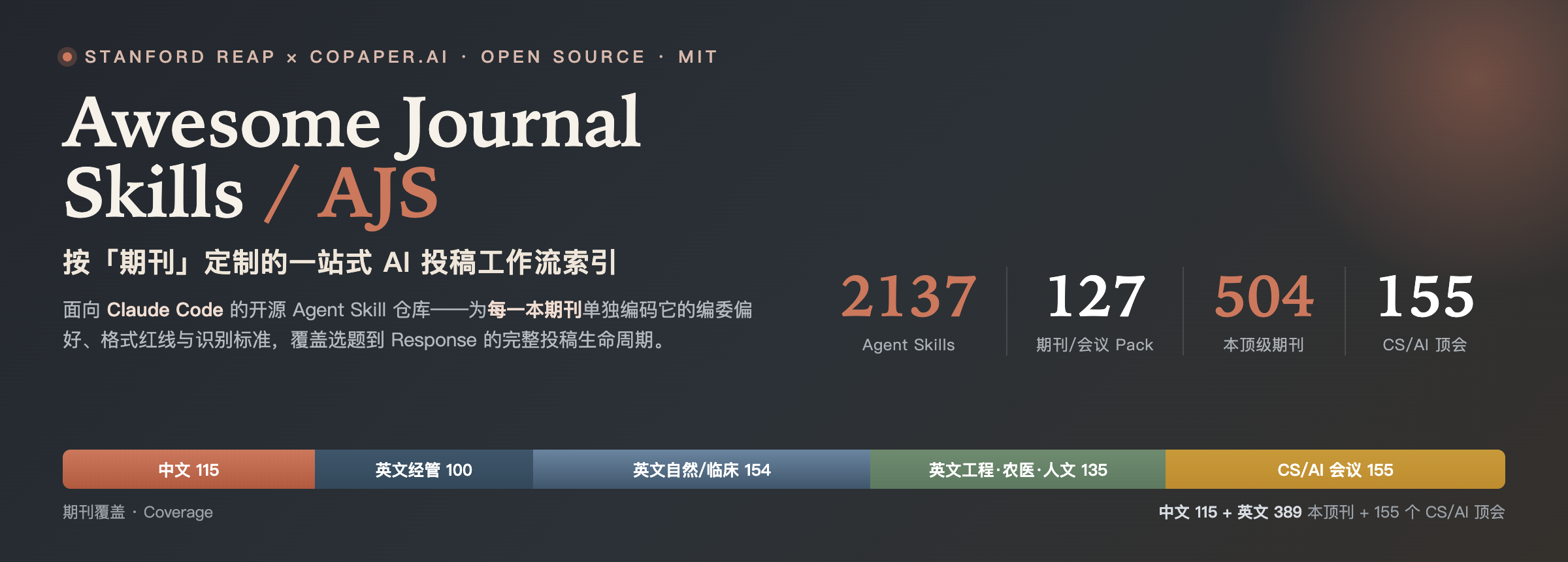
横跨经管社科 · 人文社科 · 自然科学 · 临床医学 · AI 计算机等多个主流学科,为每一本期刊 / 每一个会议单独编码它的投稿工作流。
🧭 布局指南 · 📚 Skill Pack 一览 · ⚡ 如何使用 · 🗺 路线图 · 🌐 English
先看期刊,再进 Pack。点击任意封面即可进入对应的期刊 Skill 包。


🆕 四个最新学科广度合集 —— 工程技术 40 · 农业环境 30 · 临床医学 30 · 英文人文 36;点击封面进入合集页。
其他合集 · 中文体育学 · 12 本 CSSCI 体育学来源刊











Own this plugin?
Verify ownership to unlock analytics, metadata editing, and a verified badge. GitHub access is read-only (username + org membership).
Sign in to claimOwn this plugin?
Verify ownership to unlock analytics, metadata editing, and a verified badge. GitHub access is read-only (username + org membership).
Sign in to claimnpx claudepluginhub brycewang-stanford/awesome-journal-skills --plugin jeea-skillsAI-first computer-science conference skill stack: 155 conference fit-and-submission profiles plus a CS/AI router. Covers top AI/ML, data mining, vision, NLP, robotics, HCI, systems, security, software engineering, programming languages, databases, and theory venues, with current-cycle CFP and author-kit re-check discipline.
 brycewang-stanford
Agent skill stack for submitting to 《经济研究》 (Economic Research Journal), the top economics journal in China. Eighteen skills across the manuscript lifecycle: China-context topic selection, introduction, bilingual literature review, theory & hypotheses, data & sample, modern causal identification (DID / IV / RDD / DML with heterogeneity-robust estimators), mechanism analysis (post-江艇 2022 paradigm), heterogeneity, robustness, three-line tables, policy implications, abstract, house style, reviewer-lens self-audit, reproducibility, submission preflight, and R&R rebuttals. Ships a runnable Stata + Python code library. Bilingual zh-CN / en docs.
brycewang-stanfordAgent skill stack for articles and proposals targeted at the Journal of Economic Perspectives (JEP) — the open-access, non-technical synthesis journal of the American Economic Association, founded 1987, sister to the Journal of Economic Literature (technical surveys of record) and the AER/AEJ research journals. JEP is largely invited and organized in symposia, and rewards accessible writing readable by 90 percent of AEA members, not new identification or replication. Twelve role skills cover the JEP lifecycle: workflow routing, topic selection for a broad audience, the 2–5 page proposal and symposium pitch ([email protected]), narrative arc for a general economist reader, plain-language translation of technical results, presenting evidence with minimal equations, exhibits a non-specialist can read, the JEP voice, balance and objectivity over advocacy, working with the managing-editor-led editorial team, the pre-submission preflight, and revising for accessibility and balance. Bilingual en / zh-CN docs.
brycewang-stanfordAgent skill stack for manuscripts targeted at the Journal of Financial and Quantitative Analysis (JFQA) — empirical and quantitative financial economics (corporate finance, investments, capital and security markets, financial institutions, and finance-relevant quantitative methods), published by Cambridge University Press for the Michael G. Foster School of Business at the University of Washington. Built around the JFQA realities: submission via Editorial Manager with a text-searchable PDF, a $350 fee (only $275 refunded if not sent to a reviewer), double-anonymous review, a strict one-paragraph / 100-word abstract cap, prescriptive 8.5x11 / 1-inch / 12-pt Times New Roman double-spaced formatting, a one-year resubmission ban for undisclosed prior rejections, and the JFQA Code Sharing Policy with a dedicated JFQA Dataverse at the Harvard Dataverse. Covers topic fit, literature positioning, causal/identification design for finance, robustness, tables and figures, house style, the code/data archive, referee strategy, submission preflight, and R&R rebuttals. Bilingual en / zh-CN docs; Stata / R / Python conventions.
brycewang-stanfordAgent skill stack for manuscripts targeted at Journal of Management Studies (JMS). Twelve role skills cover fit, contribution, evidence, writing, submission, and revision with source-backed JMS guardrails.
brycewang-stanfordAgent skill stack for manuscripts targeted at the European Economic Review (EER) — Elsevier's long-standing (founded 1969) general-interest European economics journal, covering all fields of economics, theory and empirical, hosted on ScienceDirect (ISSN 0014-2921). The twelve role skills span EER's distinctive process: Editorial Manager submission (editorialmanager.com/eerev), single-anonymized (single-blind) external review, a non-refundable submission fee (EUR 125 regular / EUR 100 PhD; Research4Life Group A waiver), the mandatory replication policy (data, code, and computational details deposited before publication for empirical/simulation/experimental work), Elsevier economics house style (structured abstract, JEL codes, keywords, research highlights, declaration of interest, standard errors reported), and the broad-interest bar that distinguishes EER from field journals and from the EEA flagship JEEA. Covers workflow routing, topic selection, literature positioning, identification, theory/model craft, robustness, tables and figures, writing style, the replication package, referee strategy, submission preflight, and the R&R rebuttal. Bilingual en / zh-CN docs; Stata / R / Python conventions for empirical work; volatile process facts are dated and to be re-verified on the official Elsevier / ScienceDirect pages.
brycewang-stanfordComprehensive skill pack with 66 specialized skills for full-stack developers: 12 language experts (Python, TypeScript, Go, Rust, C++, Swift, Kotlin, C#, PHP, Java, SQL, JavaScript), 10 backend frameworks, 6 frontend/mobile, plus infrastructure, DevOps, security, and testing. Features progressive disclosure architecture for 50% faster loading.
 Jeffallan
Develop, test, build, and deploy Godot 4.x games with Claude Code. Includes GdUnit4 testing, web/desktop exports, CI/CD pipelines, and deployment to Vercel/GitHub Pages/itch.io.
 Randroids-Dojo
Tools to maintain and improve CLAUDE.md files - audit quality, capture session learnings, and keep project memory current.
 anthropics
Lazy senior dev mode. Forces the simplest, shortest solution that actually works: YAGNI, stdlib first, no unrequested abstractions.
 DietrichGebert
Upstash Context7 MCP server for up-to-date documentation lookup. Pull version-specific documentation and code examples directly from source repositories into your LLM context.
 upstash





'%20stop-opacity%3D'0.16'%2F%3E%3Cstop%20offset%3D'1'%20stop-color%3D'rgb(200%2C90%2C60)'%20stop-opacity%3D'0.03'%2F%3E%3C%2FlinearGradient%3E%3C%2Fdefs%3E%3Crect%20width%3D'320'%20height%3D'200'%20fill%3D'url(%23g)'%2F%3E%3Ccircle%20cx%3D'250'%20cy%3D'56'%20r%3D'92'%20fill%3D'rgb(200%2C90%2C60)'%20fill-opacity%3D'0.06'%2F%3E%3Ccircle%20cx%3D'64'%20cy%3D'172'%20r%3D'58'%20fill%3D'rgb(200%2C90%2C60)'%20fill-opacity%3D'0.05'%2F%3E%3C%2Fsvg%3E)