Stats
Actions
Available In
Tags

Production-grade engineering skills for AI coding agents — covering the full software development lifecycle from spec to ship.
Implement tasks incrementally — build, test, verify, commit. Add "auto" to run the whole plan in one approved pass.
Simplify code for clarity and maintainability — reduce complexity without changing behavior
Design and write a new agent persona (agents/), workflow skill (skills/), or pi harness (.pi/harnesses/)
Scan agent-skills install targets for broken symlinks and stale persona references, then offer repairs
Break work into small verifiable tasks with acceptance criteria and dependency ordering
Senior code reviewer that evaluates changes across five dimensions — correctness, readability, architecture, security, and performance. Use for thorough code review before merge.
Security engineer focused on vulnerability detection, threat modeling, and secure coding practices. Use for security-focused code review, threat analysis, or hardening recommendations.
QA engineer specialized in test strategy, test writing, and coverage analysis. Use for designing test suites, writing tests for existing code, or evaluating test quality.
Web performance engineer focused on Core Web Vitals, loading, rendering, and network optimization. Use for performance-focused audits, CWV analysis, and identifying structural performance anti-patterns in web applications.
Guides stable API and interface design. Use when designing APIs, module boundaries, or any public interface. Use when creating REST or GraphQL endpoints, defining type contracts between modules, or establishing boundaries between frontend and backend.
Tests in real browsers via Chrome DevTools MCP. Use when building or debugging anything that runs in a browser. Use when you need to inspect the DOM, capture console errors, analyze network requests, profile performance, or verify visual output with real runtime data. Requires the chrome-devtools MCP server to be configured.
Automates CI/CD pipeline setup. Use when setting up or modifying build and deployment pipelines. Use when you need to automate quality gates, configure test runners in CI, or establish deployment strategies.
Conducts multi-axis code review. Use before merging any change. Use when reviewing code written by yourself, another agent, or a human. Use when you need to assess code quality across multiple dimensions before it enters the main branch.
Simplifies code for clarity. Use when refactoring code for clarity without changing behavior. Use when code works but is harder to read, maintain, or extend than it should be. Use when reviewing code that has accumulated unnecessary complexity.
Own this plugin?
Verify ownership to unlock analytics, metadata editing, and a verified badge. GitHub access is read-only (username + org membership).
Sign in to claimOwn this plugin?
Verify ownership to unlock analytics, metadata editing, and a verified badge. GitHub access is read-only (username + org membership).
Sign in to claimnpx claudepluginhub chankov/agent-skillsBased on adoption, maintenance, documentation, and repository signals. Not a security audit or endorsement.
Executables (bin/) — files in this plugin's bin/directory are added to the Bash tool's PATH while the plugin is enabled.
Production-grade engineering skills for AI coding agents — plus a thin-context multi-agent harness for pi.
Skills encode the workflows, quality gates, and best practices that senior engineers use when building software, packaged so AI agents follow them consistently across every phase of development. On pi, the agent-hub harness runs those skills and personas as a live team of specialist subagents — while keeping the dispatcher's context thin.
This is a fork of addyosmani/agent-skills, focused on Claude Code, OpenCode, and pi and adding a pi runtime layer plus npm packaging. See FORK.md for what's added, what's dropped, and how it compares.
  DEFINE          PLAN           BUILD          VERIFY         REVIEW          SHIP
 ┌──────┐      ┌──────┐      ┌──────┐      ┌──────┐      ┌──────┐      ┌──────┐
 │ Idea │ ───▶ │ Spec │ ───▶ │ Code │ ───▶ │ Test │ ───▶ │  QA  │ ───▶ │  Go  │
 │Refine│      │  PRD │      │ Impl │      │Debug │      │ Gate │      │ Live │
 └──────┘      └──────┘      └──────┘      └──────┘      └──────┘      └──────┘
  /spec          /plan          /build        /test         /review       /ship
8 slash commands that map to the development lifecycle. Each one activates the right skills automatically.
| What you're doing | Command | Key principle |
|---|---|---|
| Define what to build | /spec | Spec before code |
| Plan how to build it | /plan | Small, atomic tasks |
| Build incrementally | /build | One slice at a time |
| Prove it works | /test | Tests are proof |
| Review before merge | /review | Improve code health |
| Audit web performance | /webperf | Measure before you optimize |
| Simplify the code | /code-simplify | Clarity over cleverness |
| Ship to production | /ship | Faster is safer |
| Orchestrate a team | /orchestrate | Main session drives subagents |
/orchestrate turns the main session into an orchestrator that drives a config-defined team of subagents (default planner + builder, no reviewer), routing them as a runtime roster and handling the NEEDS_RESEARCH / PLAN_FILE handoffs. The named teams live in .claude/orchestrate-teams.yaml (mirroring pi's .pi/agents/teams.yaml) and are switchable at runtime: /orchestrate <team> "<task>". It ships for claude-code and opencode (/as-orchestrate); pi orchestrates via the agent-hub harness instead.
Want fewer manual steps once the spec exists? /build auto generates the plan and implements every task in a single approved pass — you approve the plan once, then it runs autonomously. It removes the human stepping between tasks, not the verification: every task is still test-driven and committed individually, and it pauses on failures or risky steps.
Skills also activate automatically based on what you're doing — designing an API triggers api-and-interface-design, building UI triggers frontend-ui-engineering, and so on.
agent-hub turns a single pi session into a dispatcher that drives a live team of specialist subagents — planner, builder, reviewer, test-engineer, documenter — with read-only research helpers fanning out beneath them, peer-to-peer coms messaging embedded, and a damage-control guardrail on every tool call.
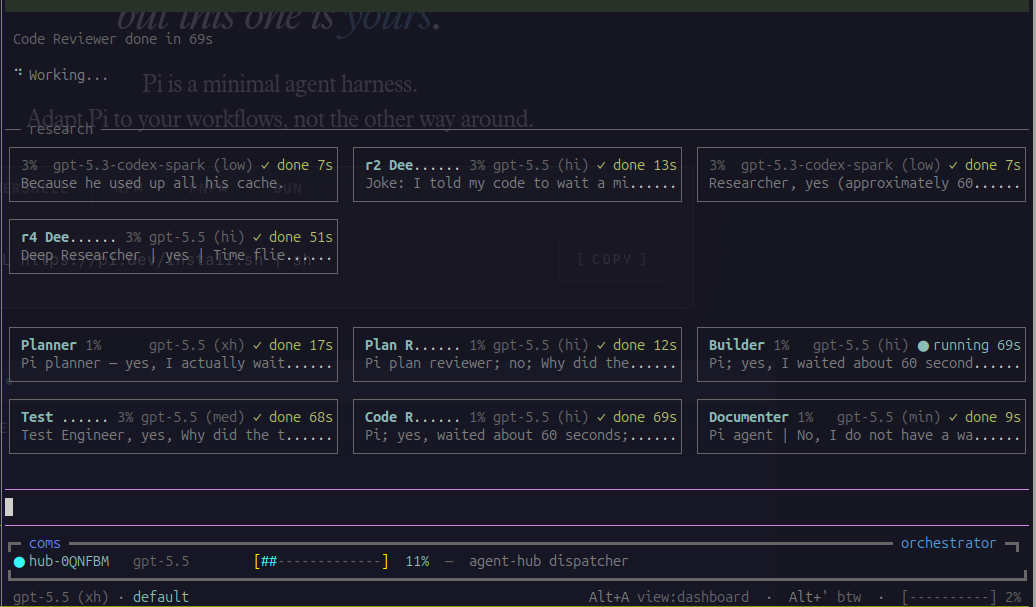
What makes it different is what it doesn't put in front of the dispatcher LLM.
Multi-agent setups usually drown the orchestrator: every subagent's output, every research dump, every verification note flows back into one context window until it compacts and forgets. agent-hub is built the other way around:
Consult multiple AI coding agents (Gemini, OpenAI, Grok, Perplexity, plus codex and antigravity CLIs when installed) to get diverse perspectives on coding problems
 hex
hexProduction-grade engineering skills for AI coding agents — covering the full software development lifecycle from spec to ship.
 addyosmani
Access thousands of AI prompts and skills directly in your AI coding assistant. Search prompts, discover skills, save your own, and improve prompts with AI.
 f
fComplete developer toolkit for Claude Code
 rohitg00
Intelligent draw.io diagramming plugin with AI-powered diagram generation, multi-platform embedding (GitHub, Confluence, Azure DevOps, Notion, Teams, Harness), conditional formatting, live data binding, and MCP server integration for programmatic diagram creation and management.
 markus41
Supergraph enforces a complete, evidence-based coding pipeline — scan → plan → TDD → fix → verify → review — grounded in real codebase analysis at every step. It combines AST dependency graphs, LSP-level code intelligence, and a structured skill chain so Claude never guesses about impact before making a change.
 datit309
'%20stop-opacity%3D'0.16'%2F%3E%3Cstop%20offset%3D'1'%20stop-color%3D'rgb(200%2C90%2C60)'%20stop-opacity%3D'0.03'%2F%3E%3C%2FlinearGradient%3E%3C%2Fdefs%3E%3Crect%20width%3D'320'%20height%3D'200'%20fill%3D'url(%23g)'%2F%3E%3Ccircle%20cx%3D'250'%20cy%3D'56'%20r%3D'92'%20fill%3D'rgb(200%2C90%2C60)'%20fill-opacity%3D'0.06'%2F%3E%3Ccircle%20cx%3D'64'%20cy%3D'172'%20r%3D'58'%20fill%3D'rgb(200%2C90%2C60)'%20fill-opacity%3D'0.05'%2F%3E%3C%2Fsvg%3E)