Stats
Actions
Available In
Tags
Agent orchestration harness for Claude Code — campaign persistence, fleet coordination, intent routing
Read-only architecture reviewer. Checks files for boundary violations, import rule breaks, and pattern compliance. Does not modify files.
Autonomous vision agent. Decomposes vague or specific direction into campaign phases. Delegates to Marshals and specialists. Reviews output against quality standards. Maintains campaign state across invocations. Does not write code — orchestrates those who do.
Parallel campaign orchestrator. Runs multiple campaigns in coordinated waves within a single session. Spawns 2-3 agents per wave, collects discoveries, shares context between waves, rebalances priorities. Does not write code — reads, plans, spawns, reviews, coordinates.
Extracts reusable patterns, pitfalls, and decisions from completed work into the project's knowledge base. Run after finishing a body of work to capture what was learned.
Given a PRD, produces an implementation architecture: file tree, component breakdown, data model, and a phased build plan with end conditions that Archon can execute directly. Multi-candidate evaluation for key decisions.
Autonomous multi-session campaign agent. Decomposes large work into phases, delegates to sub-agents, reviews output, and maintains campaign state across context windows. Use for work that spans multiple sessions and needs persistent state, quality judgment, and strategic decomposition.
Generate perfectly aligned ASCII diagrams — architecture, flow, sequence, box-and-arrow. Uses a programmatic character-grid approach so alignment is guaranteed by math, not token prediction. Includes post-render verification.
Intake-to-delivery pipeline. Processes pending items from .planning/intake/: briefs new ideas, executes approved work through research → plan → build → verify. Drop a file in .planning/intake/ and invoke this skill.
Deep cost exploration and transparency. Shows real token usage, session costs, campaign spend, burn rates, and model breakdown. Reads Claude Code's native session data for exact numbers. Complements /dashboard with focused cost views.
Uses power tools
Uses Bash, Write, or Edit tools
Own this plugin?
Verify ownership to unlock analytics, metadata editing, and a verified badge. GitHub access is read-only (username + org membership).
Sign in to claimOwn this plugin?
Verify ownership to unlock analytics, metadata editing, and a verified badge. GitHub access is read-only (username + org membership).
Sign in to claimBased on adoption, maintenance, documentation, and repository signals. Not a security audit or endorsement.





Stop re-explaining your codebase every session. Start compounding what your agents learn.
Follow on X for releases and updates · Join the discussion · Watch releases to get notified
Building something with Citadel? Drop a note in Discussions — use cases, questions, what's broken, what to build next.
Heads-up on Anthropic's routine quota: Claude Code accounts are limited to 15 routine runs per rolling 24 hours (
CronCreate/ScheduleWakeup/RemoteTrigger). A single/watchor/daemoncan exhaust it quickly and pause unrelated routines on your account. Citadel ships local, quota-free runners for each of those features — see docs/ROUTINE-QUOTA.md.
An agent orchestration harness for Claude Code and OpenAI Codex. It coordinates multiple AI agents in parallel, persists memory across sessions, and routes your intent to the cheapest execution path automatically. Citadel adapts itself to each runtime: plugin-first for Claude Code, generated project artifacts plus Codex-native config for Codex.
Without Citadel, every agent session starts from zero. You re-explain architecture decisions. You re-discover that the auth module is fragile. You copy-paste the same review checklist. When a task is too big for one agent, you manually split it and lose context between the pieces. Your agents never get better at your codebase — you just get better at prompting them.
With Citadel, sessions resume where they left off. A /do review runs a structured 5-pass review that remembers what broke last time. A /do overhaul the API layer spawns parallel agents in isolated worktrees, shares discoveries between them, and merges the results. Skills you build once compound across every future session. The system learns from its own mistakes through campaign persistence and telemetry.
The difference: CLAUDE.md and AGENTS.md tell the runtime about your project. Citadel gives the runtime the infrastructure to work autonomously — routing, memory, safety hooks, and coordination that a single guidance file can't provide.
Prerequisites: Claude Code or Codex + Node.js 18+
# 1. Clone Citadel
git clone https://github.com/SethGammon/Citadel.git

# 2a. Claude Code runtime
claude --plugin-dir /path/to/Citadel

# 2b. Codex runtime
node /path/to/Citadel/scripts/codex-compat.js
node /path/to/Citadel/scripts/install-hooks-codex.js
codex

# 3. In either runtime, run setup
/do setup

# 4. Try something
/do review src/main.ts
Quickstart for both runtimes · Claude Code installation guide · Codex installation guide · Share what you're building →
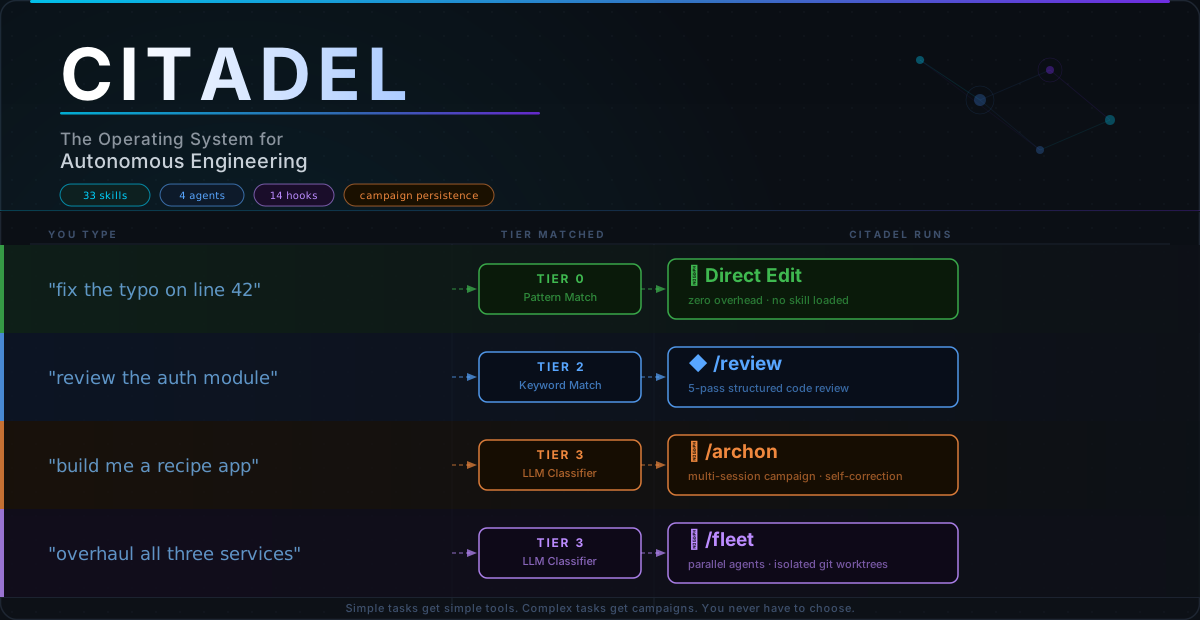
Say what you want. /do routes it to the cheapest tool that can handle it.
/do fix the typo on line 42        # Direct edit, no model call
/do review the auth module         # 5-pass structured code review
/do why is the API returning 500   # Root cause analysis
/do build a caching layer          # Multi-step orchestrated build
/do overhaul all three services    # Parallel fleet with isolated worktrees
Classification runs across four tiers, each cheaper than the last:
Most requests resolve at tiers 1-3 for free. Tier 4 is the exception, not the default. You never have to choose the tool.
npx claudepluginhub cognitive-builder/citadelAI agent skills for CopilotKit — setup, develop, integrate, debug, upgrade, and contribute to CopilotKit projects
 cognitive-builder
Unified capability management center for Skills, Agents, and Commands.
 guanyang
Ultra-compressed communication mode. Cuts 65% of output tokens (measured) while keeping full technical accuracy by speaking like a caveman.
 JuliusBrussee
Comprehensive UI/UX design plugin for mobile (iOS, Android, React Native) and web applications with design systems, accessibility, and modern patterns
 wshobson
Multi-model consensus engine integrating OpenAI Codex CLI, Gemini CLI, and Claude CLI for collaborative code review and problem-solving.
 xrf9268-hue
Comps, precedents, LBO to a branded pitch deck, end to end
 anthropics
Memory compression system for Claude Code - persist context across sessions
 thedotmack
'%20stop-opacity%3D'0.16'%2F%3E%3Cstop%20offset%3D'1'%20stop-color%3D'rgb(200%2C90%2C60)'%20stop-opacity%3D'0.03'%2F%3E%3C%2FlinearGradient%3E%3C%2Fdefs%3E%3Crect%20width%3D'320'%20height%3D'200'%20fill%3D'url(%23g)'%2F%3E%3Ccircle%20cx%3D'250'%20cy%3D'56'%20r%3D'92'%20fill%3D'rgb(200%2C90%2C60)'%20fill-opacity%3D'0.06'%2F%3E%3Ccircle%20cx%3D'64'%20cy%3D'172'%20r%3D'58'%20fill%3D'rgb(200%2C90%2C60)'%20fill-opacity%3D'0.05'%2F%3E%3C%2Fsvg%3E)