Stats
Actions
Available In
Tags

Run an adversarial multi-agent pipeline that audits, evaluates, and remediates codebases using GAN-style loops: generators produce artifacts, discriminators validate them, and feedback drives convergence across documentation, technical debt, code quality, and production readiness.
Documentation drift auditor (read-only). Six-phase audit of docs vs. code covering drift, gaps, stale docs, examples, links, config, and structure.
Documentation remediation generator. Fixes drifted docs, removes stale docs, adds stubs, and installs prevention tooling.
Implementation engineer (generator). Implements a single plan phase via TDD with atomic conventional commits.
Plan quality gate (discriminator). Adversarially reviews implementation plans for deadlocks, hallucinated files, ambiguity, and verifiability; writes feedback to feedback.md only.
Documentation quality gate (discriminator). Verifies doc fixes against source code and that prevention tooling works; writes feedback to feedback.md only.
Run one or more codebase audits (evaluation, health, documentation) with parallel agent execution, producing intake docs for a single /pipeline run.
Interactively explore a codebase and refine a feature idea into a structured design spec through clarifying questions. Use when starting a new feature.
Audit documentation against codebase reality across 6 phases (discovery, comparison, examples, links, config, structure), then produce an audit doc for /pipeline remediation.
Run the adversarial plan-implement-review pipeline. Spawns agents for each role with their own context windows. Use after /brainstorm, /repo-eval, /repo-health, or /doc-health has produced a starting doc.
Evaluate a codebase across 12 pillars (hire, stress, day 2) using 3 parallel evaluator agents, then produce an eval doc for /pipeline remediation.
Uses power tools
Uses Bash, Write, or Edit tools
Own this plugin?
Verify ownership to unlock analytics, metadata editing, and a verified badge. GitHub access is read-only (username + org membership).
Sign in to claimOwn this plugin?
Verify ownership to unlock analytics, metadata editing, and a verified badge. GitHub access is read-only (username + org membership).
Sign in to claimnpx claudepluginhub hatmanstack/claude-forge --plugin forgeBased on adoption, maintenance, documentation, and repository signals. Not a security audit or endorsement.




Blog Post · Architecture Deep Dive · Tracing
Adversarial multi-agent pipeline for Claude Code. Separate AI agents generate and critique each other's work in adversarial feedback loops, where generators produce artifacts, discriminators validate them, and iteration drives convergence. Each agent runs in its own context window with fresh perspective.
Plugin (marketplace):
/plugin marketplace add hatmanstack/claude-forge
/plugin install forge@claude-forge
/reload-plugins
The first command registers the marketplace (persisted to ~/.claude/plugins/known_marketplaces.json, so you only do it once). The second opens the install TUI — select a scope and confirm. The third activates the plugin in your current session.
When installed as a plugin, skills are prefixed with forge: — e.g. /forge:pipeline, /forge:brainstorm. The unprefixed forms (/pipeline, etc.) shown in the usage examples below apply to the standalone install path.
Standalone (copy into any project):
cp -r skills/ /path/to/your-project/.claude/skills/
cp -r agents/ /path/to/your-project/.claude/agents/
# Or personal (all projects)
cp -r skills/ ~/.claude/skills/
cp -r agents/ ~/.claude/agents/
Copy both skills/ and agents/ — the pipeline roles are native Claude Code subagents that live in agents/. When installed standalone, the orchestrator addresses them without the forge: plugin prefix (e.g. planner instead of forge:planner).
Requires Claude Code v1.0.33+ and a git-initialized project.
Claude Forge relies on the Agent and SendMessage tools for multi-agent orchestration. These now require an experimental feature flag.
Set the environment variable before launching Claude Code:
export CLAUDE_CODE_EXPERIMENTAL_AGENT_TEAMS=1
To make it permanent, add that line to your shell profile (~/.bashrc, ~/.zshrc, etc.) and restart your terminal.
Without this flag, skills that spawn or communicate with sub-agents will fail.
| Skill | Purpose | Output | Next Step |
|---|---|---|---|
brainstorm | Interactive design session, explores codebase, asks scoping questions | brainstorm.md | pipeline |
audit | Combined audit runner, select any combination of eval, health, docs | Multiple intake docs | pipeline |
repo-eval | 3-evaluator panel scoring 12 pillars | eval.md | pipeline |
repo-health | Technical debt audit across 4 vectors | health-audit.md | pipeline |
doc-health | Documentation drift detection across 6 phases | doc-audit.md | pipeline |
pipeline | Automated build/remediation cycle, routes by intake doc type | Committed code | Done |
# Feature development
/brainstorm I want to add webhook support for payment events
/pipeline 2026-03-12-payment-webhooks

# Full audit (health > eval > docs) with one pipeline run
/audit all
/pipeline 2026-03-15-audit-my-app

# Or run individual audits (each creates its own plan directory)
/repo-eval
/pipeline 2026-03-15-eval-my-app
Resume any interrupted pipeline by re-running /pipeline with the same slug.
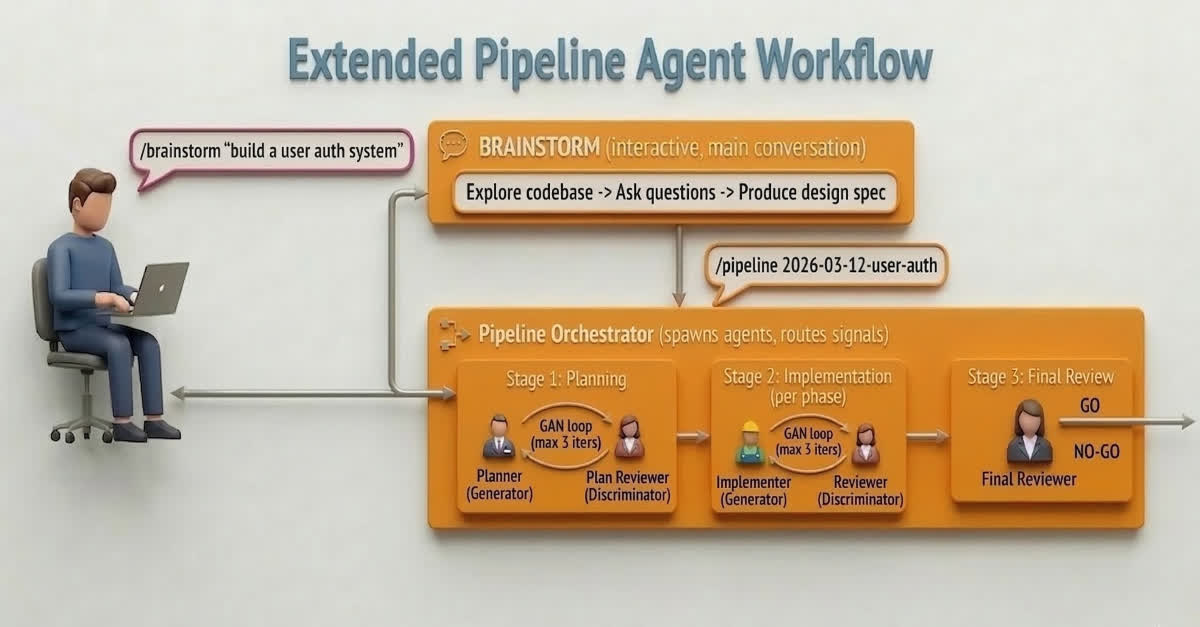
brainstorm.md)Planner ↔ Plan Reviewer → Implementer ↔ Code Reviewer → Final Reviewer
(max 3 iter) (max 3 iter/phase) GO/NO-GO
eval.md)3 Evaluators → Planner ↔ Plan Reviewer → Implementer ↔ Reviewer → Verify
(parallel) (max 3) (max 3/phase) verify findings
health-audit.md)Auditor → Planner ↔ Plan Reviewer → Hygienist ↔ Health Reviewer → Fortifier ↔ Health Reviewer → Verify
[cleanup] [guardrails] verify findings
doc-audit.md)Doc Auditor → Planner ↔ Plan Reviewer → Doc Engineer ↔ Doc Reviewer → Verify
[fix + prevent] verify findings
AI-powered development workflow automation - Phase-based planning, implementation orchestration, preflight code quality checks with security scanning, ship-it workflow, and development principles generator for CLAUDE.md
 charlesjones-dev
Code transformation: Dev SDLC orchestrator (code-shipping pipeline), plan, assert, audit, review, test, refactor, debug, for-sure. Hosts engineering agents.
 ai-driven-dev
Personal Claude Code + Codex dev stack: security hooks, AI-first code conventions, /security-review, /repo-map, /stack-check, portable statusline. Designed to complement other skills-based plugins, not replace them.
 Filip-Podstavec
Multi-agent software evolution. Autonomously study, strategize, build, review, and evaluate code changes using specialist AI agents.
 akashgit
Plan iron, verify real. Ironclad planning with independent verification chain. Turns any input into a bulletproof plan, executes with TDD, verifies with independent agents.
 malakhov-dmitrii
PROJECT.md-first autonomous development with hybrid auto-fix documentation. 8-agent pipeline, auto-orchestration, docs auto-update on commit (true vibe coding). Knowledge base system with 90% faster repeat research. Strict mode enforces SDLC best practices automatically. Works for ANY Python/JavaScript/TypeScript/Go project.
 akaszubski
'%20stop-opacity%3D'0.16'%2F%3E%3Cstop%20offset%3D'1'%20stop-color%3D'rgb(200%2C90%2C60)'%20stop-opacity%3D'0.03'%2F%3E%3C%2FlinearGradient%3E%3C%2Fdefs%3E%3Crect%20width%3D'320'%20height%3D'200'%20fill%3D'url(%23g)'%2F%3E%3Ccircle%20cx%3D'250'%20cy%3D'56'%20r%3D'92'%20fill%3D'rgb(200%2C90%2C60)'%20fill-opacity%3D'0.06'%2F%3E%3Ccircle%20cx%3D'64'%20cy%3D'172'%20r%3D'58'%20fill%3D'rgb(200%2C90%2C60)'%20fill-opacity%3D'0.05'%2F%3E%3C%2Fsvg%3E)