Stats
Actions
Available In
Tags

Mirror Claude Code sessions onto a local OpenLoomi runtime with one-command install, auto-archive every Stop into OpenLoomi memory, and manage a Loomi Pet that reflects your coding state. Query local memory, RAG knowledge, and chat insights; inspect and control the Loop proactive execution engine; and connect 1000+ external apps via Composio.
Walk the user through installing the optional composio skill and turning on screen memory
Print stable JSON status for the OpenLoomi ↔ Claude Code integration
List all /openloomi:* commands
Install, uninstall, or inspect OpenLoomi's Claude Code hooks
Show OpenLoomi Loop dashboard state (pending decisions, connectors, last tick) and force-refresh connector health — thin doorway into the openloomi-loop sub-skill
OpenLoomi × Claude Code hooks installer. Use when the user wants Claude Code's lifecycle (SessionStart, UserPromptSubmit, PreToolUse, PostToolUse, Stop, SubagentStart, SubagentStop, Notification) to mirror onto the Loomi Pet, or wants to auto-archive every Stop into OpenLoomi memory. Triggers: install hooks, /openloomi:hooks, hooks install, hooks uninstall, hooks status, mirror claude on pet, auto-archive stop.
Use 1000+ external apps via Composio - either directly through the CLI or by building AI agents and apps with the SDK
openloomi HTTP API reference (local-first, served from the OpenLoomi Desktop app at http://localhost:3414). Use when working with openloomi backend routes — auth, AI, files, integrations, RAG, memory, Loop, pet, workspace, platform callbacks. Triggers: API endpoints, backend routes, /api/*, local API, port 3414, integrations REST, OAuth start, RAG search, loop state, memory search, pet state, audit logs
openloomi Connectors tools - manage the native 7 messaging integrations and pair with the composio skill for the 1000+ apps OAuth layer (Slack, Discord, X, Gmail, Outlook, Google Calendar/Drive/Docs, GitHub, Notion, Linear, HubSpot, LinkedIn, Jira, Asana). Triggers: connect platform, integration status, list accounts, disconnect, list-accounts, status, connect, send-reply, native vs composio, 1000+ apps, list connections.
Use this when users ask about openloomi features, capabilities, or how to use it. Examples: 'openloomi 怎么用', '你能做什么', 'What can you do?', 'How does openloomi work?', 'Tell me about openloomi features', 'What platforms does openloomi support?', 'How do I use scheduled tasks?', 'What is Loop?', 'How does the attention agent work?', 'What is a Decision Card?', 'How do connectors work?', 'How do I extend Loop with custom types?', 'What is a classifier rule?', 'How do I plug openloomi into Claude Code / Codex?'
Matches all tools
Hooks run on every tool call, not just specific ones
Executes bash commands
Hook triggers when Bash tool is used
Own this plugin?
Verify ownership to unlock analytics, metadata editing, and a verified badge. GitHub access is read-only (username + org membership).
Sign in to claimOwn this plugin?
Verify ownership to unlock analytics, metadata editing, and a verified badge. GitHub access is read-only (username + org membership).
Sign in to claimBased on adoption, maintenance, documentation, and repository signals. Not a security audit or endorsement.
Modifies files
Hook triggers on file write and edit operations
Modifies files
Hook triggers on file write and edit operations
⭐ If you find OpenLoomi useful, please consider giving us a star on GitHub! It helps more people discover the project and motivates us to keep building. 🙏
Your work is scattered across apps. OpenLoomi connects the tools you use and, with your permission, understands what’s on your screen. It brings together the context behind your people, projects, and decisions, then surfaces only what needs your decision or action.
Focus on what matters. This is your Attention Agent.
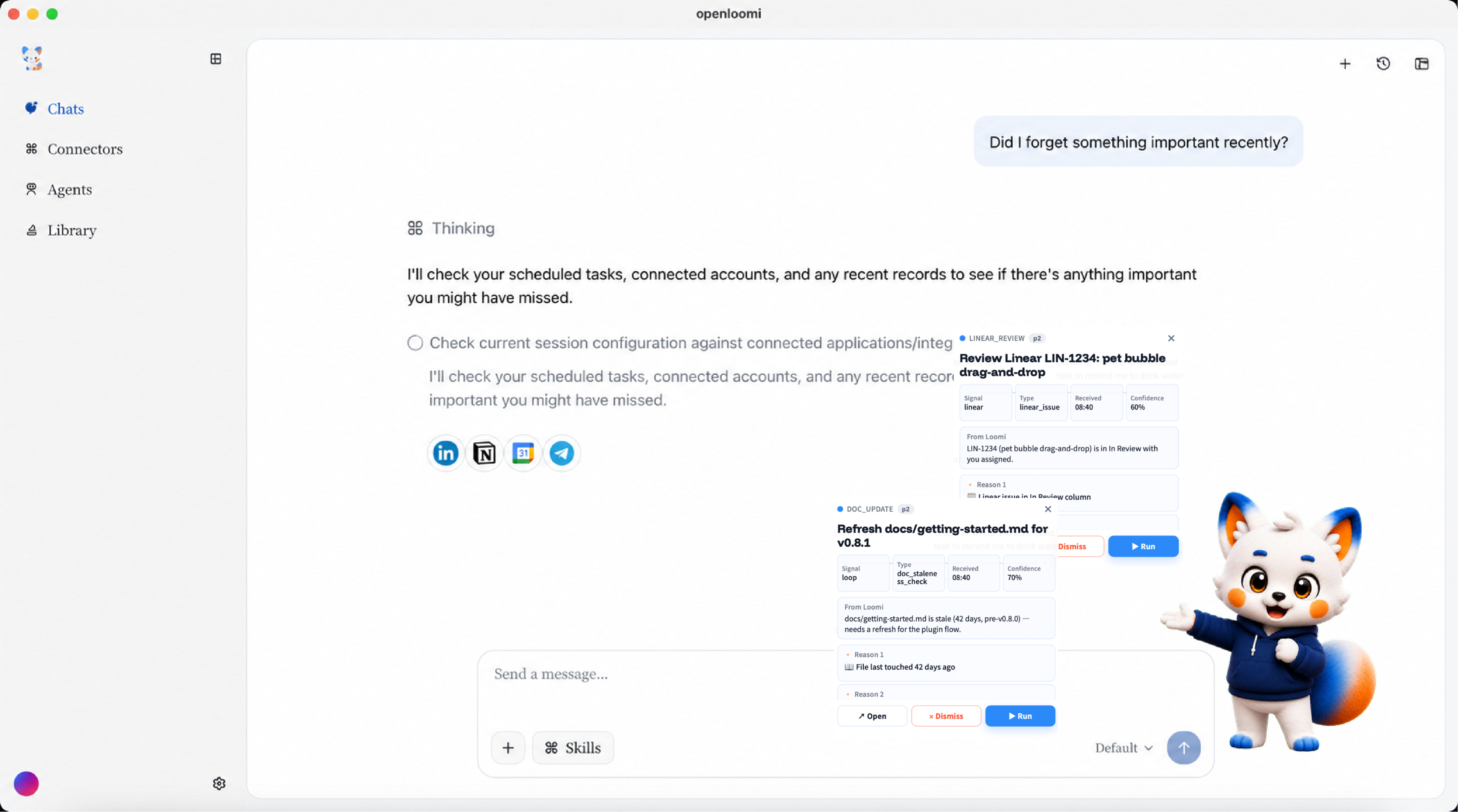
An always-on desktop attention agent — the friendly desk companion Loomi — watches the door so you don't have to, and turns the day's scattered signals into decision cards you can approve in one tap. Use it standalone, or plug any Agent framework into the same resident desktop: Claude Code, Codex, OpenCode, Hermes, and OpenClaw all work.
→ Learn more about the always-on companion in the Attention Agent docs and Use cases.
npx claudepluginhub melandlabs/openloomi --plugin openloomiNemp Memory — Cognitive memory layer for AI agents across every platform. Local-first, zero cloud, works with Claude, Codex, Cursor, and Windsurf.
 SukinShetty
Stateful agent tools for Claude Code. Learns who you are, remembers what you're working on, schedules tasks, maintains itself.
 ascorbic
Curated persistent memory for Claude Code. Write gate prevents bloat — only behavior-changing facts get saved. Tiered architecture: daily logs, structured registers, and auto-loaded working memory.
 davegoldblatt
Vault your Claude conversations. Captures session decisions, artifacts, and context across Code, Cowork, and Chat. Organizes memory by project, skill, and persona. Never re-explain yourself again.
 labyrinth-analytics
Multi-Persona-Layer for Claude Code. Per-chat agent roles (Coder, Browser, Inbox, Research) — each with its own tools, MCP servers, and system prompt. Optional, usable on top of voice or standalone.
 CorvinLabs
OpenLTM — Long-Term Memory for AI coding agents: semantic search, context injection, session learning
 RohiRIK
'%20stop-opacity%3D'0.16'%2F%3E%3Cstop%20offset%3D'1'%20stop-color%3D'rgb(200%2C90%2C60)'%20stop-opacity%3D'0.03'%2F%3E%3C%2FlinearGradient%3E%3C%2Fdefs%3E%3Crect%20width%3D'320'%20height%3D'200'%20fill%3D'url(%23g)'%2F%3E%3Ccircle%20cx%3D'250'%20cy%3D'56'%20r%3D'92'%20fill%3D'rgb(200%2C90%2C60)'%20fill-opacity%3D'0.06'%2F%3E%3Ccircle%20cx%3D'64'%20cy%3D'172'%20r%3D'58'%20fill%3D'rgb(200%2C90%2C60)'%20fill-opacity%3D'0.05'%2F%3E%3C%2Fsvg%3E)






