Stats
Actions
Available In
Tags

Generate, maintain, and query a full-codebase documentation wiki with ER diagrams, cross-service maps, health checks, and cost monitoring — all driven by slash commands and agents that auto-detect project state, ORM patterns, and tool configs.
Maintainer for AI-tool root files (CLAUDE.md, AGENTS.md, GEMINI.md, .cursor/rules/doc-wiki.mdc, .aider/conventions.md) and the per-tool configuration registry under `docs/<wiki-folder>/ai-dev/`. Generates and updates wiki-managed sections that stay in sync with the wiki. Preserves user-written content outside managed markers. Handles root-level files plus per-submodule CLAUDE.md with parent/child cross-links.
Auto Mermaid diagram generator. Converts structured agent output JSON into fenced Mermaid code blocks and injects them into wiki pages. Purely deterministic -- no LLM calls required. Supports ER diagrams, sequence diagrams, flowcharts, class diagrams, state diagrams, and more.
Detects ORM patterns in codebases and maps entities to database tables. Produces database-mapping.md with Mermaid ER diagrams. Supports 7 ORM families (JPA, SQLAlchemy, Django, Prisma, TypeORM, Entity Framework, ActiveRecord) plus custom profiles via YAML. Uses Serena MCP for code search when available, falls back to regex-based detection.
Repo-root README.md maintainer. Syncs the wiki-managed: quickstart marker block in README.md against wiki/getting-started.md, salvaging unique README content into the new generated quickstart via LLM merge. Preserves user content outside the marker pair.
Uses power tools
Uses Bash, Write, or Edit tools
Own this plugin?
Verify ownership to unlock analytics, metadata editing, and a verified badge. GitHub access is read-only (username + org membership).
Sign in to claimOwn this plugin?
Verify ownership to unlock analytics, metadata editing, and a verified badge. GitHub access is read-only (username + org membership).
Sign in to claimBased on adoption, maintenance, documentation, and repository signals. Not a security audit or endorsement.
60-second demo: media/demo.mp4 · 2-minute product overview: media/product-explainer.mp4 · reproducible benchmark: benchmark/
The LLM Wiki layer for enterprise coding agents.
Your coding agent — Claude Code, Codex, Antigravity, OpenCode, Gemini, Cursor, or Aider — reads an ecosystem-aware wiki of your code (single repo, monolith, or root-of-microservices in submodules) before it touches the diff. One command, /doc-wiki:atlas, documents the whole codebase: per-topic architecture pages, ER diagrams derived from your actual ORM models, a cross-service map generated automatically when it sees more than one service, and cited answers via /doc-wiki:query. Jira / Confluence / GitHub / GitLab / Notion / Linear / AWS / GCP and your DB schemas route in through one connector planner — configure credentials once.
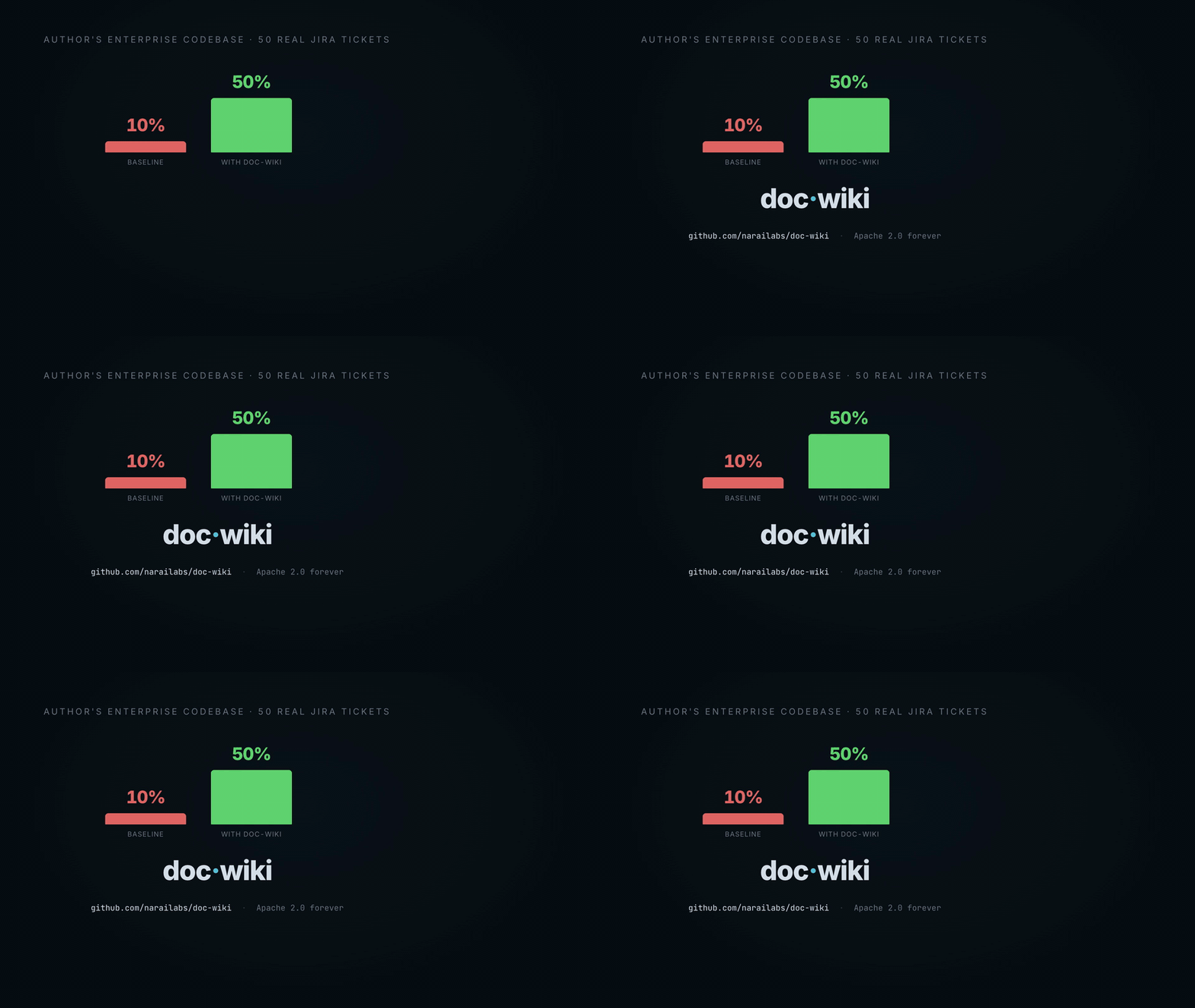
Does the wiki make the agent fix more tickets fully autonomously? We built a hardened benchmark and measured: four configurations, 92 paired runs on OSS repos — no measured lift, and we publish that null in full at benchmark/RESULTS.md. What doc-wiki demonstrably gives you is the artifact: the map, the diagrams, the history, the cited answers — context you and your agent navigate together. The author's ~10%→~50% experience on a private 500k-LOC enterprise codebase is exactly that: one engineer's anecdote, in a regime (ecosystem-heavy enterprise code, human in the loop) the benchmark doesn't reach. Scales down too: a small single-repo project gets the same wiki, leaner.
claude plugin install narailabs/doc-wiki
5-min walkthrough · reproducible benchmark · Apache-2.0 forever
doc-wiki is a tool you run inside your coding agent — Claude Code, Codex, Antigravity, OpenCode, Gemini, Cursor, and Aider all read the same wiki via their standard project-convention files (CLAUDE.md, AGENTS.md, GEMINI.md, etc. — see multi-platform wrappers). Seven /doc-wiki:* slash commands cover the full lifecycle: init (scaffold + onboard), atlas (full-codebase documentation in one pass), ingest, query, lint, edit, and stats. External services are reached through a single planner — gather() from narai-primitives — so you configure credentials once and every command can use them.
Claude Code is shockingly good on clean, small, well-documented codebases. On real-world enterprise codebases — eight years of accumulated patterns, a database schema that drifted from the ORM models three refactors ago, half the answers buried in old Jira tickets, decision rationale stuck in GitHub PR discussions from a year ago — it falls off a cliff. The model can't see what isn't in its context window, and dumping the whole repo is impossible (and useless even when it fits).
Andrej Karpathy named the LLM Wiki pattern in April 2026: a maintained, compounding artifact of distilled knowledge that an LLM reads instead of re-deriving everything from raw sources every time. doc-wiki applies that pattern to enterprise code — and extends it to ingest Jira, Confluence, GitHub, Notion, AWS, GCP, and your ORM/DB schemas, so the wiki carries the whole ecosystem your codebase actually depends on, not just the code.
The output is a structured wiki under docs/<app>-wiki/. Your coding agent reads it (via CLAUDE.md, AGENTS.md, GEMINI.md, or whichever convention your agent uses) before touching code. /doc-wiki:atlas documents an entire codebase in one phased pass; /doc-wiki:ingest keeps it current as the project evolves; /doc-wiki:query returns cited answers synthesised from wiki pages. Seven /doc-wiki:* slash commands cover the lifecycle; external services route through one planner — gather() from narai-primitives — so you configure credentials once and every command can use them. Everything runs inside your existing agent session. No SaaS, no daemon, no telemetry.
Enforced Test-Driven Development with Claude Code agent teams. Fullstack unit pipeline (backend+frontend in one unit), TypeScript verification scripts enforce anti-cheat via Bash with tsc compilation checks built-in. Script output visible in conversation — cannot be fabricated.
 narailabs
Recursive Language Model integration for Claude Code - intelligent multi-provider routing and unbounded context handling
narailabsRetrofit self-improving feedback loops into existing skills or agents. Makes any skill/agent learn from usage and mistakes, improving itself every run — without ever changing its scope.
AI-powered QA agent that uses Chrome browser tools to intelligently browse web applications, discover all screens and interactive elements, test them systematically, and automatically fix bugs it finds. Supports targeted workflow testing and bug fix cycles.
npx claudepluginhub narailabs/narai-claude-plugins --plugin doc-wikiLocal wiki-style document generator for Claude Code
 natsu1211
Create comprehensive documentation for code, APIs, and projects.
 devsforge
Use this agent when you need to analyze a service or codebase component and create comprehensive documentation in CLAUDE.md files. This agent should be invoked after implementing new services, major refactoring, or when documentation needs updating to reflect the current codebase structure. Examples: <example>Context: The user has just implemented a new authentication service and wants to document it properly. user: 'I just finished implementing the auth service, can you document how it works?' assistant: 'I'll use the codebase-documenter agent to analyze the authentication service and create detailed documentation in CLAUDE.md' <commentary>Since the user has completed a service implementation and needs documentation, use the Task tool to launch the codebase-documenter agent to create comprehensive CLAUDE.md documentation.</commentary></example> <example>Context: The user wants to ensure a newly added API module is properly documented for the team. user: 'We need documentation for the new payment processing API I just added' assistant: 'Let me use the codebase-documenter agent to analyze the payment processing API and create proper documentation' <commentary>The user needs documentation for a new API module, so use the codebase-documenter agent to create CLAUDE.md files with setup instructions and architectural notes.</commentary></example>
 ananddtyagi
Documentation generation with API docs, architecture diagrams, and tutorials
 EricGrill
Commands for generating documentation and managing changelogs
 davepoon
Complete AI coding workflow system. Self-correcting memory + persistent FTS5-indexed research wikis + auto-research loop + multi-LLM council on a single SQLite store. 33 skills, 8 agents, 22 commands, 37 hook scripts across 24 events. Cross-agent via SkillKit.
 rohitg00
'%20stop-opacity%3D'0.16'%2F%3E%3Cstop%20offset%3D'1'%20stop-color%3D'rgb(200%2C90%2C60)'%20stop-opacity%3D'0.03'%2F%3E%3C%2FlinearGradient%3E%3C%2Fdefs%3E%3Crect%20width%3D'320'%20height%3D'200'%20fill%3D'url(%23g)'%2F%3E%3Ccircle%20cx%3D'250'%20cy%3D'56'%20r%3D'92'%20fill%3D'rgb(200%2C90%2C60)'%20fill-opacity%3D'0.06'%2F%3E%3Ccircle%20cx%3D'64'%20cy%3D'172'%20r%3D'58'%20fill%3D'rgb(200%2C90%2C60)'%20fill-opacity%3D'0.05'%2F%3E%3C%2Fsvg%3E)