Stats
Actions
Available In
Tags

Enforce a structured, spec-driven multi-agent development methodology with drift detection, audit trails, and architectural governance for Claude Code projects.
Log and metrics analyst — reads .cladding/audit.log.jsonl, perf/baseline.json, and drift reports; surfaces patterns the human can act on. Activate only when the connected project contains spec.yaml or the user explicitly names Cladding; ignore ordinary requests in uninitialized projects.
<!-- AUTO-GENERATED by scripts/build-plugin.mjs — do not edit. -->
Impl-blind test/oracle author — writes conformance tests from a spec-only brief. Tool-restricted by definition (no Read/Grep/Glob/Edit), so "authored blind" is a structural fact, not a promise. Activate only when the connected project contains spec.yaml or the user explicitly names Cladding; ignore ordinary requests in uninitialized projects.
Implementer — writes production code, tests, and migrations. The "generic engineer" fallback when no narrower specialist exists. Activate only when the connected project contains spec.yaml or the user explicitly names Cladding; ignore ordinary requests in uninitialized projects.
Workflow conductor — sequences agents based on the 5 invocation principles. Routes user intent to the right persona. Activate only when the connected project contains spec.yaml or the user explicitly names Cladding; ignore ordinary requests in uninitialized projects.
Admin access level
Server config contains admin-level keywords
Executes bash commands
Own this plugin?
Verify ownership to unlock analytics, metadata editing, and a verified badge. GitHub access is read-only (username + org membership).
Sign in to claimOwn this plugin?
Verify ownership to unlock analytics, metadata editing, and a verified badge. GitHub access is read-only (username + org membership).
Sign in to claimBased on adoption, maintenance, documentation, and repository signals. Not a security audit or endorsement.
Hook triggers when Bash tool is used
Hook triggers when Bash tool is used
Modifies files
Hook triggers on file write and edit operations
Modifies files
Hook triggers on file write and edit operations
Uses power tools
Uses Bash, Write, or Edit tools
Uses power tools
Uses Bash, Write, or Edit tools
To trust AI with coding, an organization needs three things — that the code can be trusted,
that it's traced, and that it holds up as you scale. cladding builds those three.
True to its name (cladding = the outer layer), it wraps your host LLM (Claude Code · Codex · Gemini · Antigravity · Cursor): before it starts, cladding feeds it the project's intent; after it finishes, cladding verifies the result with 41 detectors and a 15-stage gate.





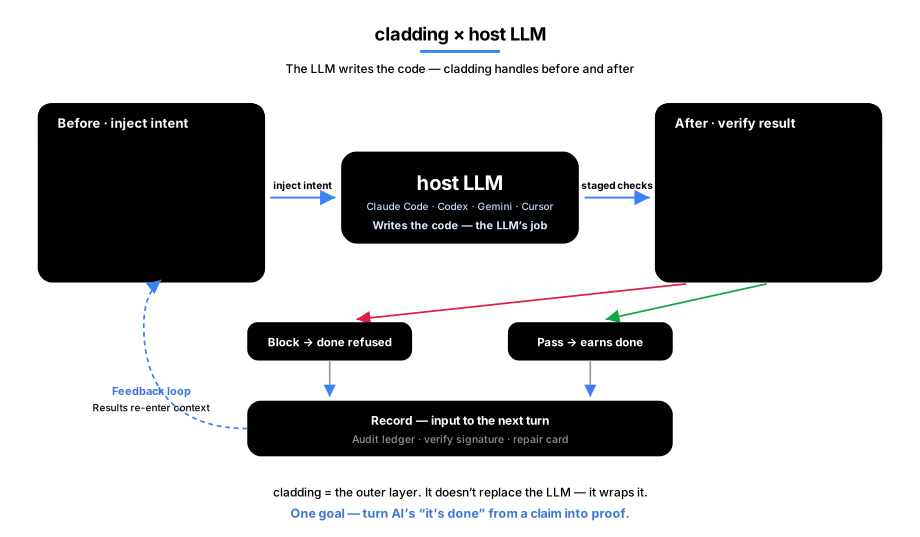
This loop is after one thing — turning the AI's "it's done" from a claim into a proof.
So you can ship AI-written code held to the same standard as human-written code — the three things an organization needs to hand coding to AI:
done; an "it's done" you can't verify never passes.cladding builds itself with cladding too — 252 of its 255 features cleared this same gate, the first L4 implementation of the Ironclad standard.
The same situation, in a vanilla AI setup and in cladding.
| Situation | Vanilla AI coding | cladding |
|---|---|---|
| Code drifts from the spec | fixed if a reviewer notices | auto-detected right after the edit · "done" can't pass while it's drifting |
| The AI says "it's done" | you take its word | done earned only when the gate is GREEN |
| Ending a session in a failing state | exits as-is, forgotten next time | the exit is blocked once, the failing checks handed off as a repair card |
| Two devs add a feature at the same time | merge conflict | hash-8 IDs · separate files → 0 conflicts |
| Who verifies the AI-written code? | the AI that wrote it self-certifies (risky) | an implementation-blind grader + the mechanical gate |
| Switching AI tools | reconfigure per tool | one spec → 5 hosts wired automatically |
done. (Automating it in a loop? That's the loop section.)done is recorded with the proof that it actually passed, so months later "was this verified? why was it built this way?" is answered by the repo, not by memory.Before — inject the intent, so the LLM starts with the right context:
Multi-agent development harness for Claude Code. Your AI has speed; we give it direction — through living specs and focused specialist agents.
 qwerfunch
npx claudepluginhub qwerfunch/cladding --plugin claude-codeMulti-agent development workflow (/crew) — planning, implementation, review, documentation, evals, and audit gates. Commands, agents, and skills are auto-discovered from the repo.
 Spiris-Innovation-Tech-Dev
Personal Claude Code + Codex dev stack: security hooks, AI-first code conventions, /security-review, /repo-map, /stack-check, portable statusline. Designed to complement other skills-based plugins, not replace them.
 Filip-Podstavec
Multi-session continuity, parallel Agent Teams coordination, and mechanical quality enforcement for Claude Code.
 oeftimie
Battle-tested Claude Code plugin for engineering teams — 38 agents, 156 skills, 72 legacy command shims, production-ready hooks, and selective install workflows evolved through continuous real-world use
 mrebrahim
OSS Claude Code config: agents, skills, and hooks for professional AI-assisted development workflows
 Borda
BordaSDLC enforcement for AI agents — TDD, planning, self-review, CI shepherd
 BaseInfinity
'%20stop-opacity%3D'0.16'%2F%3E%3Cstop%20offset%3D'1'%20stop-color%3D'rgb(200%2C90%2C60)'%20stop-opacity%3D'0.03'%2F%3E%3C%2FlinearGradient%3E%3C%2Fdefs%3E%3Crect%20width%3D'320'%20height%3D'200'%20fill%3D'url(%23g)'%2F%3E%3Ccircle%20cx%3D'250'%20cy%3D'56'%20r%3D'92'%20fill%3D'rgb(200%2C90%2C60)'%20fill-opacity%3D'0.06'%2F%3E%3Ccircle%20cx%3D'64'%20cy%3D'172'%20r%3D'58'%20fill%3D'rgb(200%2C90%2C60)'%20fill-opacity%3D'0.05'%2F%3E%3C%2Fsvg%3E)