Stats
Actions
Available In
Tags

Turns Fable 5 into a token-frugal orchestrator: Fable keeps judgment, tiered Opus/Sonnet/Haiku agents do the labor.
Deep technical work. Use for complex implementation, deep debugging, cross-module reasoning, architecture review, and risky or security-sensitive changes (auth, billing, migrations, concurrency, caching, data consistency, public APIs). Also reviews work from cheaper agents for hidden flaws.
Standard engineering execution. Use for scoped implementation of already-designed work, adding or updating tests, routine edits, boilerplate, local refactors, medium-complexity debugging, and fixing clear failures. Does not make product calls or change architecture.
Cheap evidence gathering. Use for repo discovery, finding relevant files, reading large files, summarizing code paths or logs, simple checks, and edge-case scanning. Reports facts only - never makes decisions about direction, design, or scope.
Independent evidence-based verification. Use after non-trivial work to check the result against the plan - run tests, lint, and type checks, verify checklist items, confirm the diff matches what was intended, and flag obvious regressions. Reports pass/fail with evidence; never fixes anything.
Matches all tools
Hooks run on every tool call, not just specific ones
Uses power tools
Uses Bash, Write, or Edit tools
Own this plugin?
Verify ownership to unlock analytics, metadata editing, and a verified badge. GitHub access is read-only (username + org membership).
Sign in to claimOwn this plugin?
Verify ownership to unlock analytics, metadata editing, and a verified badge. GitHub access is read-only (username + org membership).
Sign in to claimBased on adoption, maintenance, documentation, and repository signals. Not a security audit or endorsement.


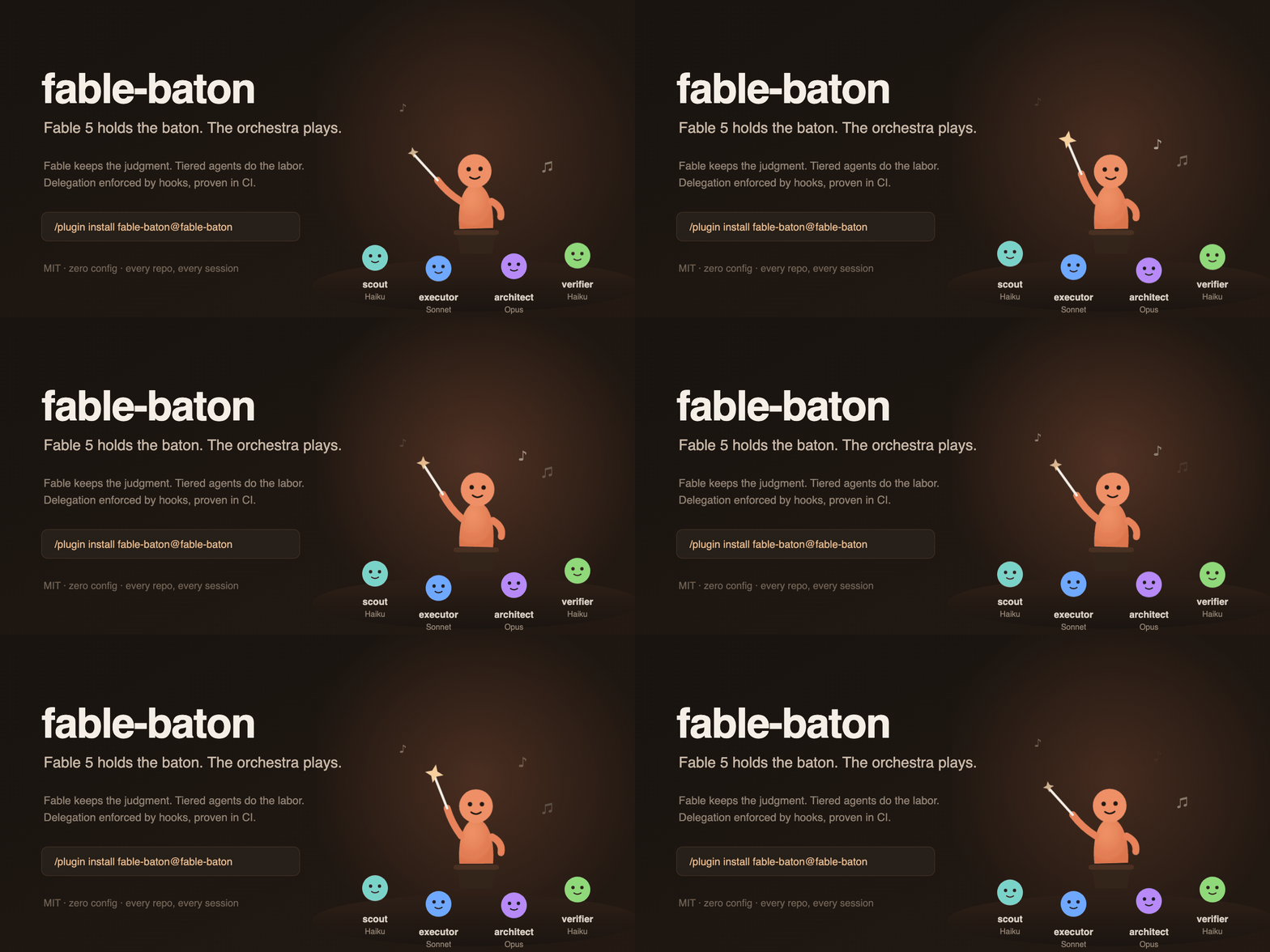
Fable 5 holds the baton. The orchestra plays.
A Claude Code plugin that makes Fable 5 the orchestrator. Fable keeps the judgment, tiered subagents on Opus, Sonnet and Haiku do the labor. Install once and every new session in every repo starts this way.
Why · Benchmark · How it works · What you'll see · Install · Day-to-day · Alternatives
The tiers are Opus, Sonnet and Haiku today. Later this should open up to other models and structures.
Numbers from a small controlled test, run 2026-07-13 on Claude Code 2.1.197 with plugin v1.3.0. The project was a zero dependency Node.js library with a test suite. Three tasks: fix two seeded bugs, implement a feature from a spec in TODO.md, and review the codebase for bugs. Each task ran headless via claude -p, twice with the plugin off and twice with it on, same session model (Fable 5) in both. Success was checked from outside the session: the test suite had to pass (for the feature task against hidden tests the session never saw) and the review had to find both seeded bugs. All 12 runs passed.
| task | plugin off, total cost | plugin on, total cost | plugin on, cost split | Fable output tokens, off / on |
|---|---|---|---|---|
| bugfix | $0.96 | $1.15 | Fable $0.92, Sonnet $0.19, Haiku $0.04 | 2.4k / 2.2k |
| feature | $1.52 | $1.50 | Fable $1.05, Sonnet $0.39, Haiku $0.06 | 6.1k / 3.4k |
| review | $2.13 | $2.71 | Fable $1.61, Opus $1.05, Haiku $0.05 | 13.7k / 8.5k |
Values are per run averages over the two reps. Read the table honestly. Total API cost comes out about the same and sometimes higher, because orchestration adds coordination on top of the work. What changes is where the tokens land. Fable's own output tokens drop 44 percent on the feature task and 38 percent on the review, and its share of the cost drops with them. That work moves to Sonnet, Haiku and Opus. If you pay per token through the API and only care about the total, the plugin will not save you money on small tasks. If you are on a subscription where Fable quota is what runs out and triggers the mid session model switch, this is the tradeoff you want: Fable stays available for judgment much longer and the session keeps its conductor.
Keep in mind this is n=2 per cell on one small project, and variance between reps was real (one review run cost $3.25, the other $2.16). Treat the numbers as directional. The benchmark harness is not shipped with the plugin.
| Agent | Model | Owns |
|---|---|---|
scout | Haiku | Discovery, reading files/logs, summaries, simple checks |
executor | Sonnet | Scoped implementation, tests, routine edits, local refactors |
architect | Opus | Complex implementation, deep debugging, high-risk work, reviewing cheaper agents |
verifier | Haiku | Evidence checks: tests green, diff matches plan, no regressions |
A SessionStart hook injects the orchestration policy into every new session. It tells Fable what to keep (intent, architecture, tradeoffs, review) and what to route down (labor), with anti-waste rules: no pointless fan-out, focused context per agent, no delegation for genuinely trivial single steps.
A one-time policy is not enough. Models drift back to doing everything inline as a session goes on. We watched it happen in real sessions.
| Layer | Hook | What it does |
|---|---|---|
| Policy | SessionStart | Loads the full orchestration policy when the session starts |
| Reminder | UserPromptSubmit | Re-asserts the delegation rules on every prompt |
| Counter | PostToolUse | Counts consecutive inline tool calls and injects a delegation notice once a streak crosses the threshold (default 4, set with FABLE_BATON_TRIPWIRE, resets whenever an agent is used) |
The model can still ignore a notice. But ignoring a fresh instruction mid-streak is much harder than forgetting something from page one.
npx claudepluginhub realgarit/fable-baton --plugin fable-batonRun Fable 5 as a coordinator: plan big, execute small. Bulk reading — codebase sweeps, log triage, document review, web research, coverage verification — fans out to parallel workers pinned to Sonnet/Haiku, and only distilled findings enter Fable's premium context. Ported to Claude Code from Anthropic's plan-big-execute-small cookbook.
 czlonkowski
Turn your strongest Claude model into a team-lead orchestrator: it plans and reviews, delegates execution to the cheapest capable workers (Claude subagents or auto-detected Codex CLI workers), and blind-verifies meaningful changes before accepting them.
 olsenbrands
Self-enforcing engineering methodology extracted from Claude Fable 5 for less advanced models: prime directives + integrity rules injected each session, 26 on-demand skills, 4 contracted subagents (builder, qa-verifier, code-reviewer, research-scout), and 6 lifecycle hooks that gate destructive commands and unverified 'done' claims.
 UnpaidAttention
Run your session on Claude's most capable model as a full-time architect: it writes specs and verdicts while Grok 4.5 (via the Grok CLI) and GPT-5.6 Sol at high reasoning (via Codex) do the typing. Fable-level judgment with cross-vendor implementation.
 DannyMac180
Token-frugal multi-agent orchestration for Claude Code, built for a Claude Fable 5 chair: Fable plans and decides, Sonnet 5 carries the volume, Opus 5 takes the hard slices and escalations — each worker's effort sized by the chair — and a two-tier verification valve guards the close. When the Fable limit runs dry, an Opus fallback profile keeps the same discipline running. A Requirements Ledger and guard hooks enforce the discipline mechanically, and finished tmux teammates are reaped automatically.
 Rylaa
RylaaIntelligent model routing for Claude Code - routes queries to optimal Claude model (Haiku/Sonnet/Opus) based on complexity, with persistent knowledge system, context forking, and multi-turn awareness
 0xrdan
'%20stop-opacity%3D'0.16'%2F%3E%3Cstop%20offset%3D'1'%20stop-color%3D'rgb(200%2C90%2C60)'%20stop-opacity%3D'0.03'%2F%3E%3C%2FlinearGradient%3E%3C%2Fdefs%3E%3Crect%20width%3D'320'%20height%3D'200'%20fill%3D'url(%23g)'%2F%3E%3Ccircle%20cx%3D'250'%20cy%3D'56'%20r%3D'92'%20fill%3D'rgb(200%2C90%2C60)'%20fill-opacity%3D'0.06'%2F%3E%3Ccircle%20cx%3D'64'%20cy%3D'172'%20r%3D'58'%20fill%3D'rgb(200%2C90%2C60)'%20fill-opacity%3D'0.05'%2F%3E%3C%2Fsvg%3E)