Stats
Actions
Available In
Tags

Run autonomous hypothesis-tree research workflows inside Claude Code using your own model, managing idea trees via git worktrees, evaluating hypotheses with smoke/full tests, and generating structured reports—all without API keys or external services.
Coordinator phase for Arbor: persistent ReAct loop, Idea Tree state, INIT/OBSERVE/IDEATE/SELECT/DISPATCH/DECIDE protocol, tool mapping, cycle caps, and coordinator-only behavior. Use after setup/intake and before phase-specific ideation, executor, merge, search, or report skills.
Executor-dispatch phase for Arbor. Use when implementing an Idea Tree node through RunExecutor or RunExecutorParallel semantics: isolated git worktree, executor prompt construction, eval metadata injection, RunTraining policy, smoke/full evaluation, report parsing, artifact persistence, tree update, and insight propagation.
Strict IDEATE-stage skill for Arbor. Use immediately after TreeView(format="constraints") when drafting Idea Tree nodes, enforcing the idea_drafting and first_principles_probe behavior, depth-aware idea levels, four-line TreeAddNode hypotheses, conflict checks, and self-filtering against shallow tweaks.
Merge and evaluation discipline for Arbor. Use for TreeSetMeta metadata, B_dev/B_test separation, eval command templates, score parsing, GitMergeBranch behavior, protected paths, required outputs, metric_direction, trunk/test score updates, medal detection, and final evaluation before stopping.
Top-level controller for recreating the open-source AutoResearch workflow as a suite of skills. Use when the user asks to run, emulate, extract, validate, or refine Arbor/AutoResearch behavior, especially when a coordinator must load phase skills for setup, ideation, executors, merge evaluation, novelty search, plugins, resume, and reports.
Own this plugin?
Verify ownership to unlock analytics, metadata editing, and a verified badge. GitHub access is read-only (username + org membership).
Sign in to claimOwn this plugin?
Verify ownership to unlock analytics, metadata editing, and a verified badge. GitHub access is read-only (username + org membership).
Sign in to claimBased on adoption, maintenance, documentation, and repository signals. Not a security audit or endorsement.







English | 简体中文
Arbor is an autonomous research agent that turns a long-horizon objective into a cumulative search. Give it a benchmark and a goal; it proposes hypotheses, edits code, runs real experiments, learns from the results, and keeps the improvements that hold up on held-out data. Instead of one-shot attempts that forget what failed, Arbor grows a hypothesis tree: every idea becomes a branch — pruned if it fails, harvested if it works — and insights propagate back so later ideas start smarter.
For more details, visit our project page and read the paper. For a more detailed usage manual, see our documentation. 🧭 You can also choose the CLI or Skill version depending on your environment and workflow.
https://github.com/user-attachments/assets/49c1a306-d2e9-49d6-9c83-65e38a62df30
arbor idea-check "<your idea>", or let the Coordinator vet every new branch automatically. See Literature Search & Novelty Checks. 🔎main is never touched until you merge.arbor idea-check.
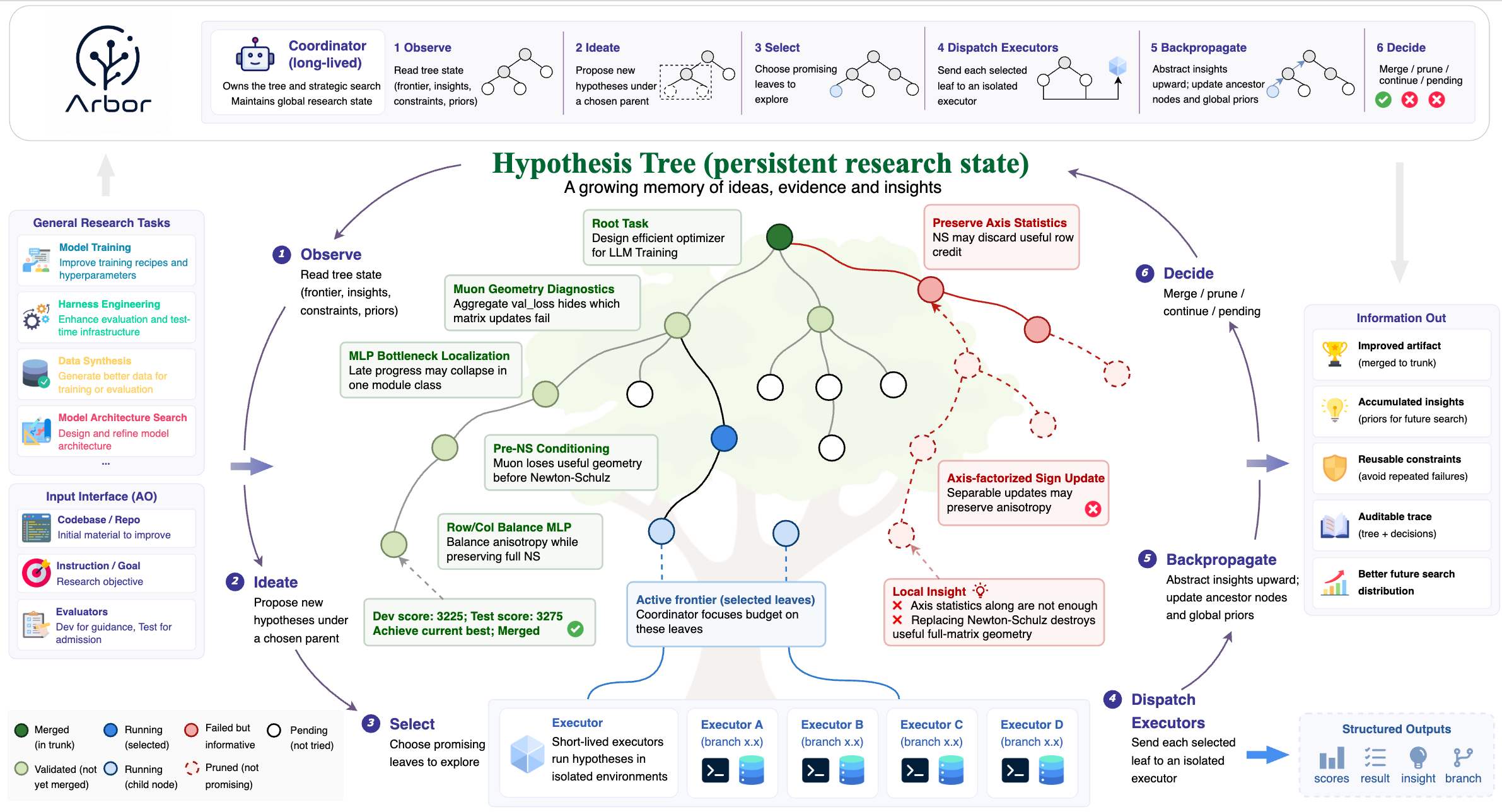
Arbor runs two cooperating agents:
npx claudepluginhub ruc-nlpir/arbor --plugin arborAutonomous research loops with 10 commands. Generalizes Karpathy's autoresearch loop to any domain with mechanical evaluation, overnight persistence, and zero dependencies.
 wjgoarxiv
Autonomous, personalized research loops for Claude Code. Set a topic, walk away, come back to a quality-gated report adapted to your projects.
 primeline-ai
Oh My Paper research harness: memory system, Codex delegation, and pipeline commands for academic research projects.
 LigphiDonk
Academic research agents — hypothesis generation, experiment design, paper drafting, peer review simulation, and more.
 richard-kim-79
Autonomous research orchestration: agents for hypothesis-driven investigation, experiment running, fresh-eyes review, and batch evaluation.
 Butanium
Scientific research agent extension - turns research goals into reproducible Jupyter notebooks with Python REPL, data analysis, and ML workflows
 Yeachan-Heo
'%20stop-opacity%3D'0.16'%2F%3E%3Cstop%20offset%3D'1'%20stop-color%3D'rgb(200%2C90%2C60)'%20stop-opacity%3D'0.03'%2F%3E%3C%2FlinearGradient%3E%3C%2Fdefs%3E%3Crect%20width%3D'320'%20height%3D'200'%20fill%3D'url(%23g)'%2F%3E%3Ccircle%20cx%3D'250'%20cy%3D'56'%20r%3D'92'%20fill%3D'rgb(200%2C90%2C60)'%20fill-opacity%3D'0.06'%2F%3E%3Ccircle%20cx%3D'64'%20cy%3D'172'%20r%3D'58'%20fill%3D'rgb(200%2C90%2C60)'%20fill-opacity%3D'0.05'%2F%3E%3C%2Fsvg%3E)