Stats
Actions
Available In
Tags

Orchestrate end-to-end development workflows with automatic context management, safety gates, and multi-agent coordination — plan, code, test, deploy, monitor across sessions with quality and security enforcement.
Pre-implementation red-team analysis. Challenges plans BEFORE code is written — edge cases, security holes, scalability bottlenecks, error propagation. Catches flaws at plan time (10x cheaper).
Fast codebase scanner — finds files, patterns, dependencies, project structure. Pure read-only. Use BEFORE planning, fixing, reviewing, or refactoring.
Feature implementation orchestrator — handles 70% of requests. Full TDD cycle: understand → plan → test → implement → verify → commit. Use for ANY code modification (features, bugs, refactors, security).
Database workflow specialist — migration generation (up + down), breaking change detection, index recommendations, SQL injection scanning. Use when schema changes detected.
Root cause analysis ONLY — investigates errors, traces stack traces, forms/tests hypotheses. Does NOT fix code. Hands diagnosis to fix. Use when root cause is unknown.
Clone, port, or convert features from any GitHub repo into your project. Use when stealing patterns from external repos or porting proven code. Understand before copy, challenge before implement. 4 modes: port (rewrite), compare (analysis), copy (transplant), improve (copy + optimize).
Verify AI-generated imports, API calls, and packages actually exist. Use when finishing AI-generated code that introduces new imports or external API calls — auto-fires after fix/cook to catch phantom functions, non-existent packages, and slopsquatting attacks.
Engineering retrospective. Analyzes commit history, work patterns, and code quality metrics with trend tracking. Per-person breakdowns, shipping streaks, and actionable improvements. Use when asked for "retro", "weekly review", "what did we ship", or "engineering retrospective".
Step-by-step complex reasoning for multi-variable problems. Breaks interconnected decisions into ordered logical steps with bias detection, reversibility classification, and second-order effect tracking.
Universal context persistence across sessions. Auto-saves decisions, conventions, and progress to .rune/ files. Loads state at session start. Use when any skill makes architectural decisions or establishes patterns that must survive session boundaries.
Executes bash commands
Hook triggers when Bash tool is used
Modifies files
Hook triggers on file write and edit operations
Own this plugin?
Verify ownership to unlock analytics, metadata editing, and a verified badge. GitHub access is read-only (username + org membership).
Sign in to claimOwn this plugin?
Verify ownership to unlock analytics, metadata editing, and a verified badge. GitHub access is read-only (username + org membership).
Sign in to claimBased on adoption, maintenance, documentation, and repository signals. Not a security audit or endorsement.
Uses power tools
Uses Bash, Write, or Edit tools
Uses power tools
Uses Bash, Write, or Edit tools
No model invocation
Executes directly as bash, bypassing the AI model
No model invocation
Executes directly as bash, bypassing the AI model
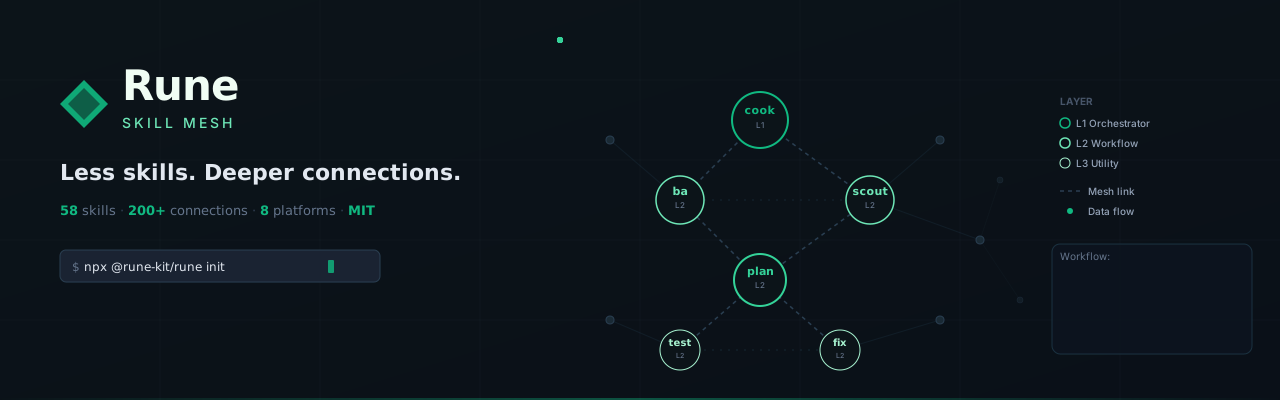
Less skills. Deeper connections.
A lean, interconnected skill ecosystem for AI coding assistants.
64 skills · 203 connections · 40 signals · 13 platforms · MIT




Claude Code (native plugin) · Cursor · Windsurf · Google Antigravity · OpenAI Codex · OpenCode · Aider · GitHub Copilot CLI · Gemini CLI · Qoder · Qwen Coder · any AI IDE
Most skill ecosystems are either too many isolated skills (540+ that don't talk to each other) or rigid pipelines (A → B → C, if B fails everything stops).
Rune is a mesh — 64 skills with 203 connections + 40 signals across a 5-layer architecture. Skills call each other bidirectionally, forming resilient workflows that adapt when things go wrong.
Pipeline:  A → B → C → D         (B fails = stuck)
Hub-Spoke: A → HUB → C           (HUB fails = stuck)
Mesh:      A ↔ B ↔ C             (B fails = A reaches C via D→E)
           ↕       ↕
           D ↔ E ↔ F
We ran 10 standardized coding tasks on Claude Code — once without Rune (vanilla), once with Rune — and measured tokens, cost, duration, and correctness.
                Without Rune    With Rune     Delta
Avg Tokens:     541,400         454,491       ↓ 16%
Avg Cost:       $0.69           $0.65         ↓ 6%
Avg Duration:   2.3 min         2.1 min       ↓ 9%
Avg Tool Calls: 14              13            ↓ 7%
Correctness:    9/10            9/10          =
| Task | Difficulty | Tokens | Cost | Duration | Tools |
|---|---|---|---|---|---|
| Refactor 450-line component | Medium | -62% | -17% | -32% | -27% |
| Full feature (auth + API + tests) | Complex | -36% | -29% | -31% | -27% |
| Add Zod validation | Easy | -9% | -28% | -32% | 0% |
| Dark mode across 6 components | Hard | ~0% | +10% | -7% | -6% |
Rune doesn't make Claude smarter — Claude already knows how to code. Rune makes Claude disciplined. The more complex the task, the more discipline matters.
"Without Rune, Claude writes code that works. With Rune, Claude writes code that lasts."
| # | Task | Diff | Tokens | Cost | Time | Correct |
|---|---|---|---|---|---|---|
| 1 | Zod Validation | Easy | -9% | -28% | -32% | ✅ → ✅ |
| 2 | Fix N+1 Query | Easy | +12% | +25% | +3% | ❌ → ❌ |
| 3 | Cursor Pagination | Med | +12% | +19% | -9% | ✅ → ✅ |
| 4 | Security Review | Med | +13% | +32% | +3% | ✅ → ✅ |
| 5 | Rate Limiting | Med | +12% | +5% | +5% | ✅ → ✅ |
| 6 | Refactor Component | Med | -62% | -17% | -32% | ✅ → ✅ |
| 7 | Dark Mode (6 files) | Hard | ~0% | +10% | -7% | ✅ → ✅ |
| 8 | DB Migration | Hard | +52% | +11% | +49% | ✅ → ✅ |
| 9 | Memory Leak Debug | Hard | +13% | +28% | -2% | ✅ → ✅ |
| 10 | Full Auth System | Complex | -36% | -29% | -31% | ✅ → ✅ |
Methodology: Claude Code CLI headless mode (claude -p --output-format json), 10 tasks with fixture code, pattern-based correctness evaluation. Source: Benchmark/
npx claudepluginhub rune-kit/rune --plugin @rune/chrome-extProduction-ready Claude Code configuration with role-based workflows (PM→Lead→Designer→Dev→QA), safety hooks, 44 commands, 19 skills, 8 agents, 43 rules, 30 hook scripts across 19 events, auto-learning pipeline, hook profiles, and multi-language coding standards
 xiaobei930
Autonomous multi-agent development framework with spec-driven sprints and convergent iteration
 jeremylongshore
Verification-first engineering toolkit for Claude Code. 15 skills across a 5-phase spine (Investigate → Design → Implement → Verify → Ship), 8 specialist agents, an interactive setup wizard. Every skill has rationalizations + evidence requirements. Built for senior ICs and tech leads.
 duthaho
Multi-agent orchestration for code that matters.
 ShankarKakumani
Corca Workflow Framework — consolidated hooks and skill orchestration for structured development sessions
 corca-ai
Custom commands, skills, agents, rules, hooks, and output styles for Claude Code - session continuity and modern CLI tooling for real-world development workflows
 0xDarkMatter
'%20stop-opacity%3D'0.16'%2F%3E%3Cstop%20offset%3D'1'%20stop-color%3D'rgb(200%2C90%2C60)'%20stop-opacity%3D'0.03'%2F%3E%3C%2FlinearGradient%3E%3C%2Fdefs%3E%3Crect%20width%3D'320'%20height%3D'200'%20fill%3D'url(%23g)'%2F%3E%3Ccircle%20cx%3D'250'%20cy%3D'56'%20r%3D'92'%20fill%3D'rgb(200%2C90%2C60)'%20fill-opacity%3D'0.06'%2F%3E%3Ccircle%20cx%3D'64'%20cy%3D'172'%20r%3D'58'%20fill%3D'rgb(200%2C90%2C60)'%20fill-opacity%3D'0.05'%2F%3E%3C%2Fsvg%3E)