Stats
Actions
Available In
Tags
Make evidence-gated product decisions by scoping context, gathering and rating evidence, then ranking opportunities, deciding on bets, pressure-testing plans, and writing decision artifacts. Tunes scoring constants against past outcomes and detects scope drift via snapshot comparison.
Tune and validate the scoring constants (evidence-weight base, diversity factors, gate threshold, crispness bars) against past decisions with known outcomes. Use when the user says "calibrate", "tune the thresholds", "validate the scoring", "the confidence numbers feel off", or has a set of past decisions to check the model against. Reports mismatches and recommended constant changes; never silently changes them.
Use when someone wants existing thinking attacked, graded, or handed to fresh eyes, not written or summarized. The point is to break the artifact, not produce it. It owns three intents: a skeptical outside read of conclusions, findings, themes, a synthesis, a brief, or a FAQ, from someone who was not in the room; running those findings past hostile lenses (a wary customer, CFO, engineer, competitor) to see where they collapse; and grading a problem statement or one-liner (right altitude, names a real persona, or vague mush) with a score and what is missing. Reach for it on 'give this a fresh adversarial read', 'put this in front of a skeptical X', 'score how crisp this problem statement is', 'poke holes', 'red-team this'. Do not use it to create or restate the artifact. Attacking a whole plan, roadmap, or PRD routes through pressure-test; this skill owns findings, syntheses, problem statements, and panels.
Judge whether there is enough evidence to make a build decision on a specific problem or bet, and return one of three outcomes: Decide now, Run a research sprint, or Do not commit yet. Use when the user asks "do we have enough data to decide?", "is this worth building?", "are we ready to commit to X?", "what's the evidence for this?", or "decision readiness". This is the core gate, Confidence band drives the decision; signal strength is assessed per evidence item.
Turn a "Run a research sprint" verdict (promising but under-evidenced) into the cheapest experiment that would close the gap, a concrete validating test with a hypothesis, method, sample, effort, and pass/fail threshold. Use when decision-readiness returns Run a research sprint, or when the user asks "how do we validate this", "what's the cheapest test", "how do we de-risk this bet", or has a promising idea with thin first-party evidence. Designs the test; its results feed back into gather-evidence. Do NOT use to pull existing data (that is gather-evidence) or to judge sufficiency (that is decision-readiness).
Map what product-data sources a user can draw on, connectors, tools, files, offline systems, and the decision-confidence ceiling those sources allow. Use when the intent is discovery and setup of the evidence base itself: "what data do I have / could connect", "scan/inventory my sources", "is X hooked up", "where could product insights come from", "how confident could any decision be given my data", or starting a new project before any framing or prioritizing. Do NOT use when the user wants you to actually work the data they already have, pulling, summarizing, grading, or reporting on tickets, reviews, surveys, metrics, scorecards, or trends. Those are analysis and reporting tasks, not source discovery. The trigger is "what evidence exists and how good can it get," not "analyze the evidence." Produces a source map plus a confidence ceiling.
Own this plugin?
Verify ownership to unlock analytics, metadata editing, and a verified badge. GitHub access is read-only (username + org membership).
Sign in to claimOwn this plugin?
Verify ownership to unlock analytics, metadata editing, and a verified badge. GitHub access is read-only (username + org membership).
Sign in to claimBased on adoption, maintenance, documentation, and repository signals. Not a security audit or endorsement.
Find what's worth building next, with the evidence to prove it.
product-eval discovers and analyzes real customer problems from the tools where they already live: support tickets (Zendesk), CRM (Salesforce, HubSpot), issue trackers (Jira), product analytics, and reviews. It weighs the evidence, ranks what matters, and builds a prioritized, evidence-backed narrative of the problem worth solving.
When a bet is ready, hand it off: export a brief or decision memo, or pass a build spec straight to a wireframing tool or an AI coding agent like Codex or Claude Code to ship an MVP. It runs in both Claude Code and Codex, and keeps the rigor (evidence weighting, readiness gates, audit files) behind a simple, outcome-first chat.
It helps you answer four practical questions:
The plugin keeps the rigor behind the scenes: it can discover available sources, gather and weight evidence, synthesize themes into buildable problems, score Value and Confidence, check decision readiness, and produce decision artifacts. Users should not need to choose those internal steps directly; they can describe the outcome they want.
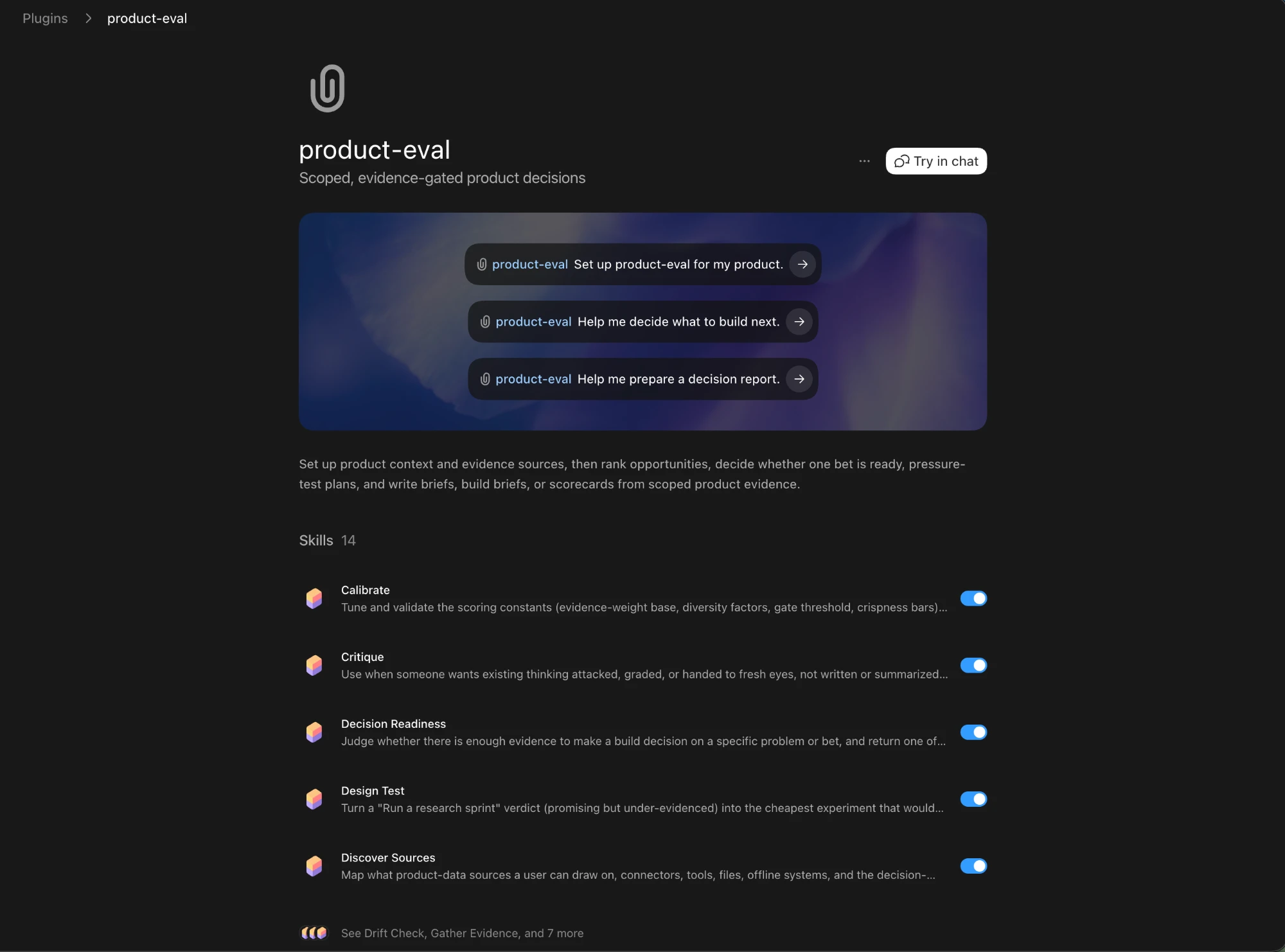
Cowork: open the .plugin file. It renders as an installable card; click to add it.
Claude Code: add this directory or its hosting repo as a plugin marketplace, then install:
/plugin marketplace add <path-or-repo>
/plugin install product-eval
Codex: this source is Codex-compatible through .codex-plugin/plugin.json. For Codex marketplace installation, place or symlink this folder as <marketplace-root>/plugins/product-eval, make sure that marketplace root is registered with Codex, then install product-eval from that marketplace. This repo cleanup does not create or edit global Codex marketplace config such as ~/.agents/plugins/marketplace.json.
Quick install (either tool, no marketplace): clone this repo and run ./install.sh. It symlinks the 14 skills into ~/.claude/skills and ~/.agents/skills, so a later git pull keeps them current. In Codex, invoke a skill explicitly with $<skill-name> (for example $start).
After installing, start by setting up the product context and decision:
On first run, product-eval should ask for the product, target users, decision goal, scope/time horizon, available evidence sources, and the metric or business constraint that should shape the recommendation. It should not rank a vague area like "onboarding" or judge a bet like "SSO" until the product context and evidence plan are clear, unless you explicitly ask for an outside-in first pass with a lower confidence ceiling.
Each step should end with a Next move that points toward delivery: upload the evidence, rank the candidates, run the readiness call, pressure-test the plan, write the decision memo, render the scorecard, or hand a build brief to Codex/design.
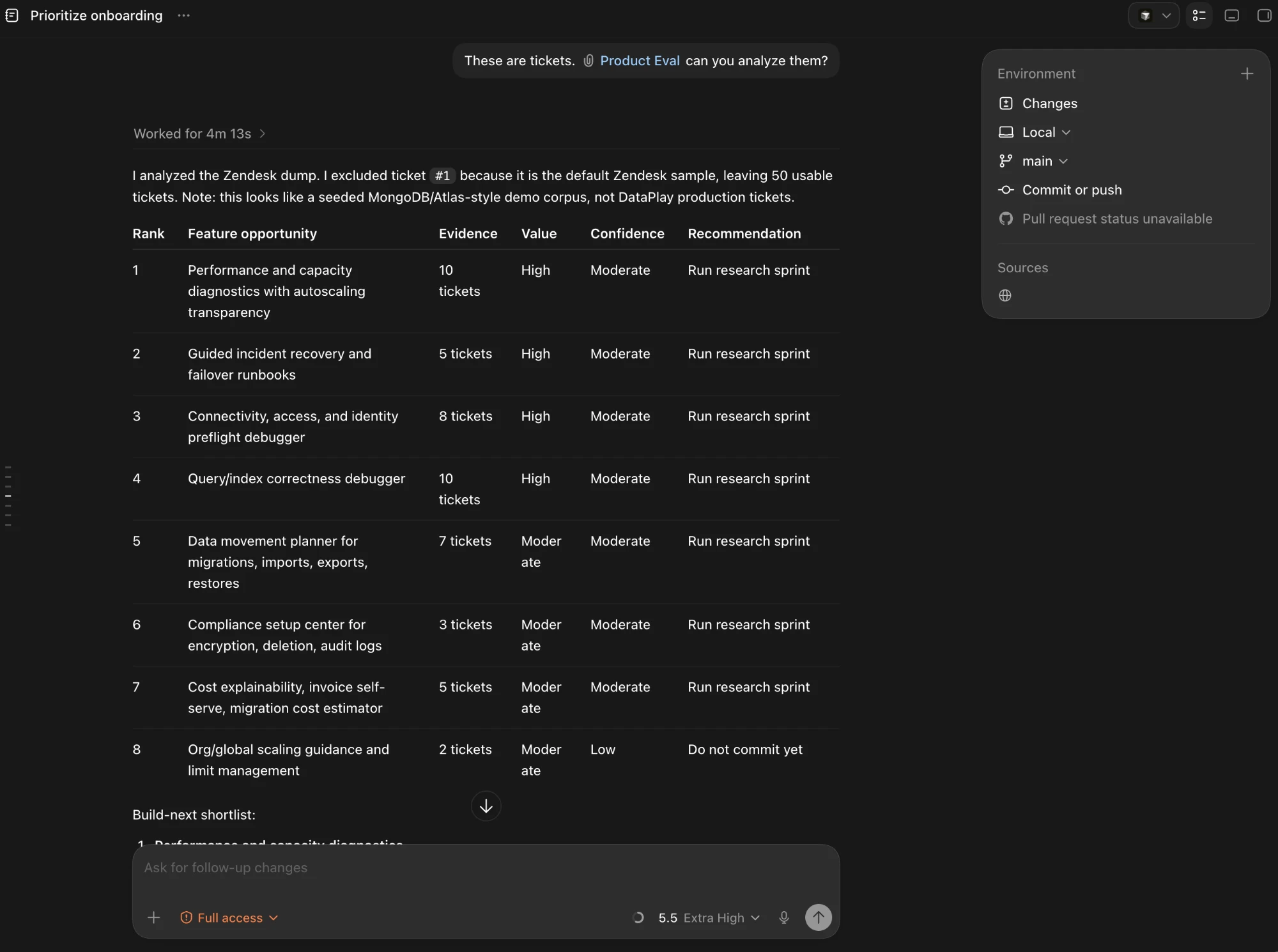
Point it at your customer signal and ask for the outcome. For example, hand it a support-ticket export in Codex:
"These are our support tickets. Can you analyze them?"
product-eval runs the full chain (gather and weight evidence, synthesize themes, score Value and Confidence, run the readiness gate) and returns a ranked shortlist with a verdict on each.
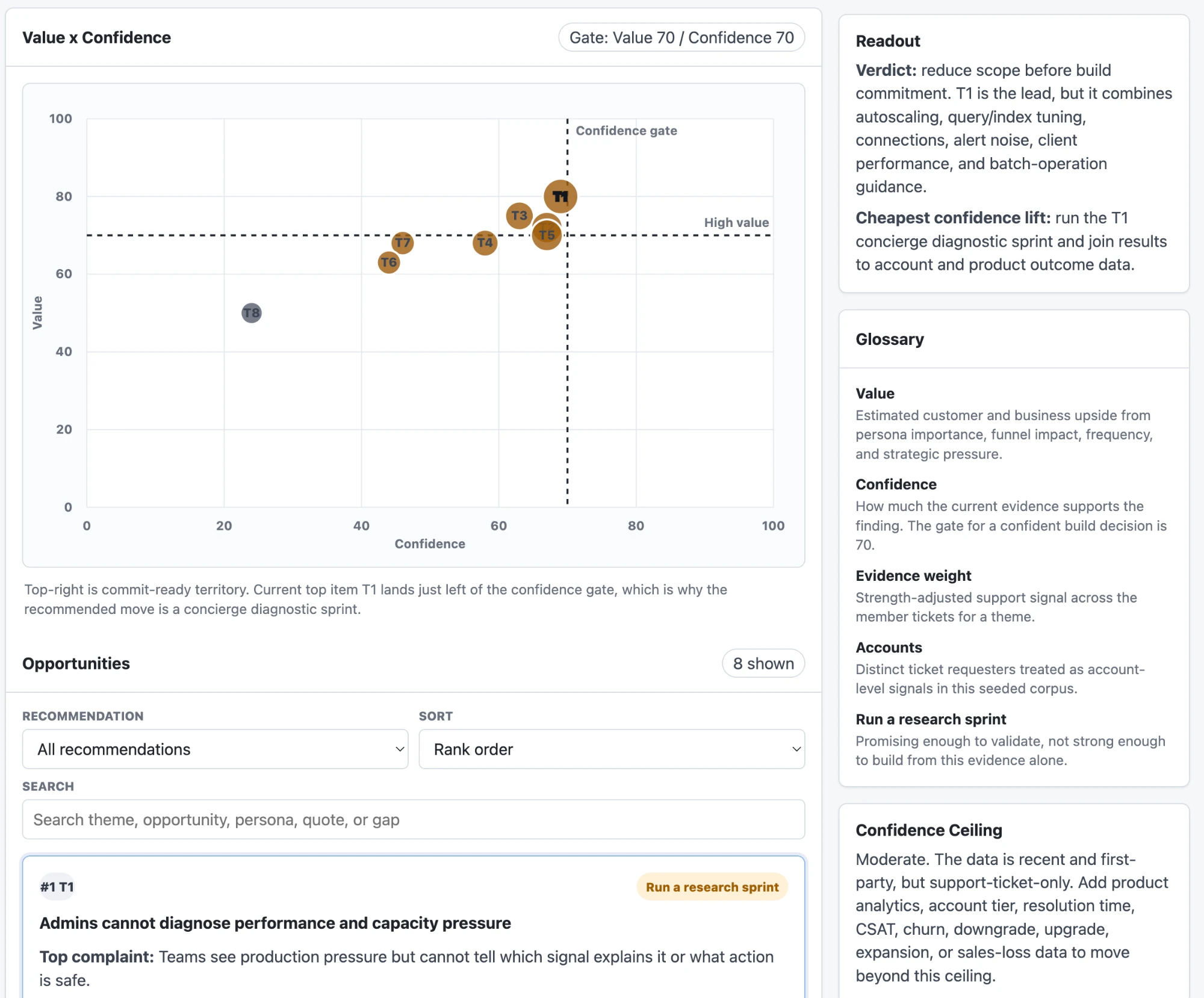
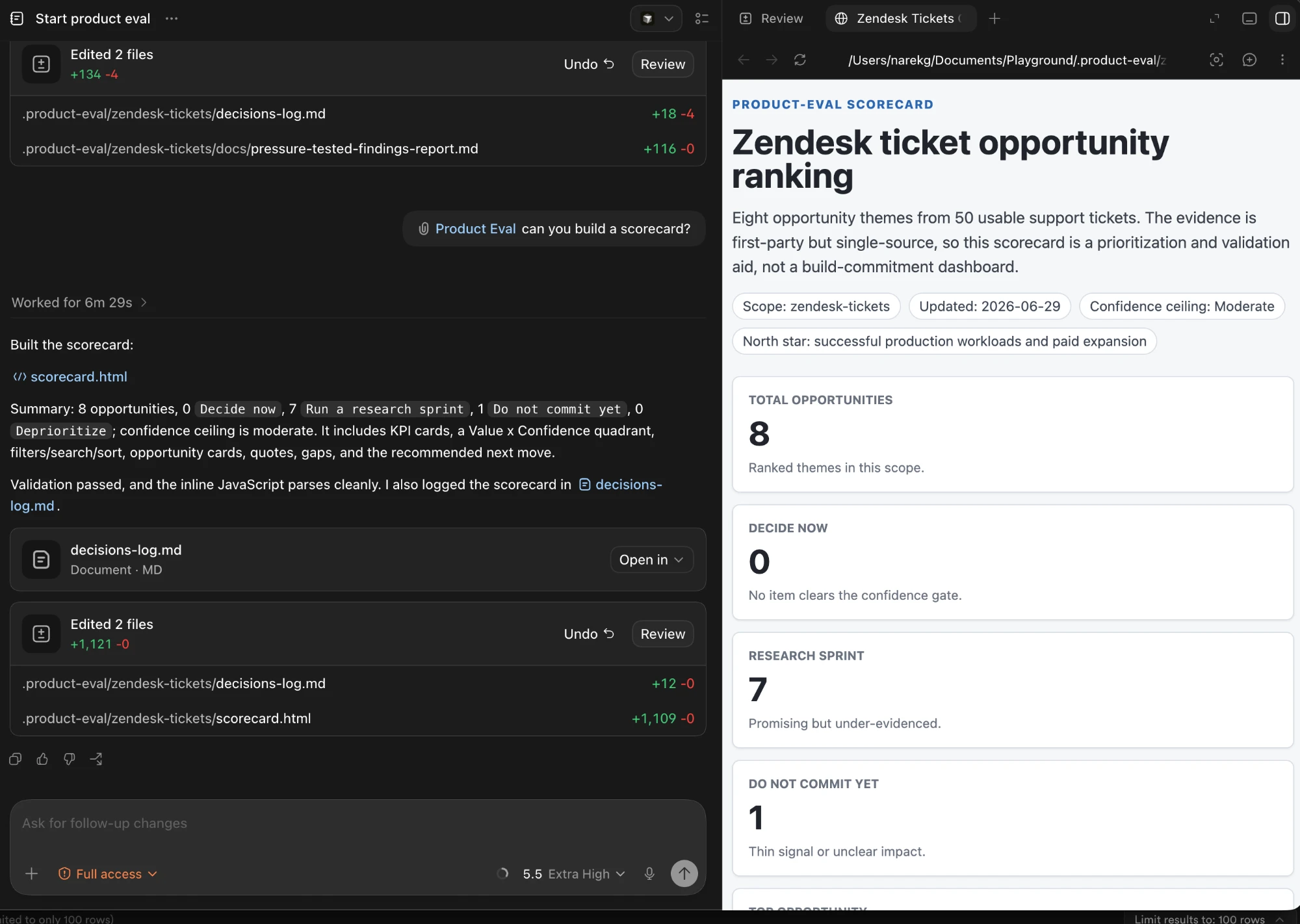
Ask for a scorecard and it builds a self-contained, shareable HTML dashboard:
"Can you build a scorecard?"
No data of your own? It also works top-down from a domain ("research the observability tooling space and tell me what's worth building"), reasoning from public signal and stating the resulting confidence ceiling. You can also open a ready-made example with zero setup: examples/activation-q3/scorecard.html.
Use this when you have a product area, evidence pile, or backlog and want a ranked shortlist. The plugin gathers or reads evidence, turns themes into buildable problem statements, scores each item by Value and Confidence, and returns a ranked table with the best next move.
npx claudepluginhub sparkline-ventures/product-eval18 production-ready Claude Code skills for Product Managers. Discovery, build, measure, communicate.
 Mehdibargach
Product discovery skills for PMs: ideation, experiments, assumption testing, feature prioritization, and customer interview synthesis.
 phuryn
Agent-first PM toolkit with 9 specialist agents and 18 skills for solo developers and small teams
 slgoodrich
Write feature specs, plan roadmaps, and synthesize user research faster. Keep stakeholders updated and stay ahead of the competitive landscape.
 anthropics
Strategic thinking partner for product decisions. Works through problems conversationally, challenges assumptions, helps you ship faster. Grounded in frameworks from Marty Cagan, Teresa Torres, Elena Verna, Brian Balfour, Chip Huyen, Ryan Singer, Hamel Husain, and more. Complete eval chain from first 20 test cases through error analysis, LLM judges, and RAG evaluation. Plus backlog automation with Linear/GitHub integration.
 breethomas
The Product Manager's Operating System. AI-powered skills for every PM workflow: PRDs, prioritization, competitive intel, stakeholder updates, launch planning, and more.
 shaan-ad
'%20stop-opacity%3D'0.16'%2F%3E%3Cstop%20offset%3D'1'%20stop-color%3D'rgb(200%2C90%2C60)'%20stop-opacity%3D'0.03'%2F%3E%3C%2FlinearGradient%3E%3C%2Fdefs%3E%3Crect%20width%3D'320'%20height%3D'200'%20fill%3D'url(%23g)'%2F%3E%3Ccircle%20cx%3D'250'%20cy%3D'56'%20r%3D'92'%20fill%3D'rgb(200%2C90%2C60)'%20fill-opacity%3D'0.06'%2F%3E%3Ccircle%20cx%3D'64'%20cy%3D'172'%20r%3D'58'%20fill%3D'rgb(200%2C90%2C60)'%20fill-opacity%3D'0.05'%2F%3E%3C%2Fsvg%3E)