Stats
Actions
Available In
Tags

Claude plans, delegates, and tastes every plate. Sonnet, Codex, or GLM does the knife work. A Claude Code plugin for the orchestrator/implementer split: /serve runs the whole line autonomously (implement, cross-review, fix, verify), /fire hands specced implementation to the worker, /taste runs cross-model review, /refire fixes what the review found, /simmer loops the worker under Claude's judgment, /mise sets up the kitchen, /receipts prints the check.
Own this plugin?
Verify ownership to unlock analytics, metadata editing, and a verified badge. GitHub access is read-only (username + org membership).
Sign in to claimOwn this plugin?
Verify ownership to unlock analytics, metadata editing, and a verified badge. GitHub access is read-only (username + org membership).
Sign in to claimBased on adoption, maintenance, documentation, and repository signals. Not a security audit or endorsement.
Delegates a well-specified implementation task to Codex CLI (or, via --with, Claude Sonnet 5 or opt-in GLM-5.2) in the background. Use when the user asks to hand work to Codex, or for substantial spec-able work - features, refactors, migrations, boilerplate; offer first unless the routing policy is autonomous. Not for small fixes or ambiguous design; never fire silently.
Mise en place - setup and health check. Verifies Codex CLI and auth, installs the delegation profile, scaffolds AGENTS.md, and offers the routing policy. Re-run anytime, and after plugin updates to refresh the profile. Use when the user asks to set up sous-chef, or when another sous-chef skill fails because Codex or the profile is missing.
Prints the check - reads .sous-chef/receipts/ and renders the last 10 run receipts as a table with a savings total, and can reprint any receipt's shareable summary. Use when the user asks for receipts, costs, or savings, or invokes /sous-chef:receipts. Receipts are written automatically at the end of every serve and simmer.
Turns confirmed findings from a taste into one scoped fix run, then re-verifies each finding at its cited location. Use after /sous-chef:taste when the user says to fix the findings, apply the review, or refire it. Not for new feature work - that is a fresh /sous-chef:fire.
Runs the whole line autonomously - implement via Codex, cross-review, fix confirmed findings, verify, report once at the end. Use when the user wants a task done end to end ("serve this", "just get it done"), or as the default for spec-able implementation when the routing policy is autonomous. Announces once; stops only for hard blockers.


Fable 5 orchestrates and reviews; Sonnet 5, GPT-5.5, or GLM 5.2 implements. Your head chef doesn't chop onions.
A Claude Code plugin that splits coding between two frontier models the way a kitchen splits work. Fable plans, writes the ticket, reviews every diff line by line, and re-runs the checks itself. Sonnet, Codex, or GLM does the implementation, with no say over what ships. The split is economic: Fable is the most expensive model on the line, so its tokens go to judgment and worker tokens go to bulk. In the measured setup this pattern is built on, Codex did ~20x the implementation work per orchestration round trip, and two mid-tier subscriptions often beat one top-tier one.
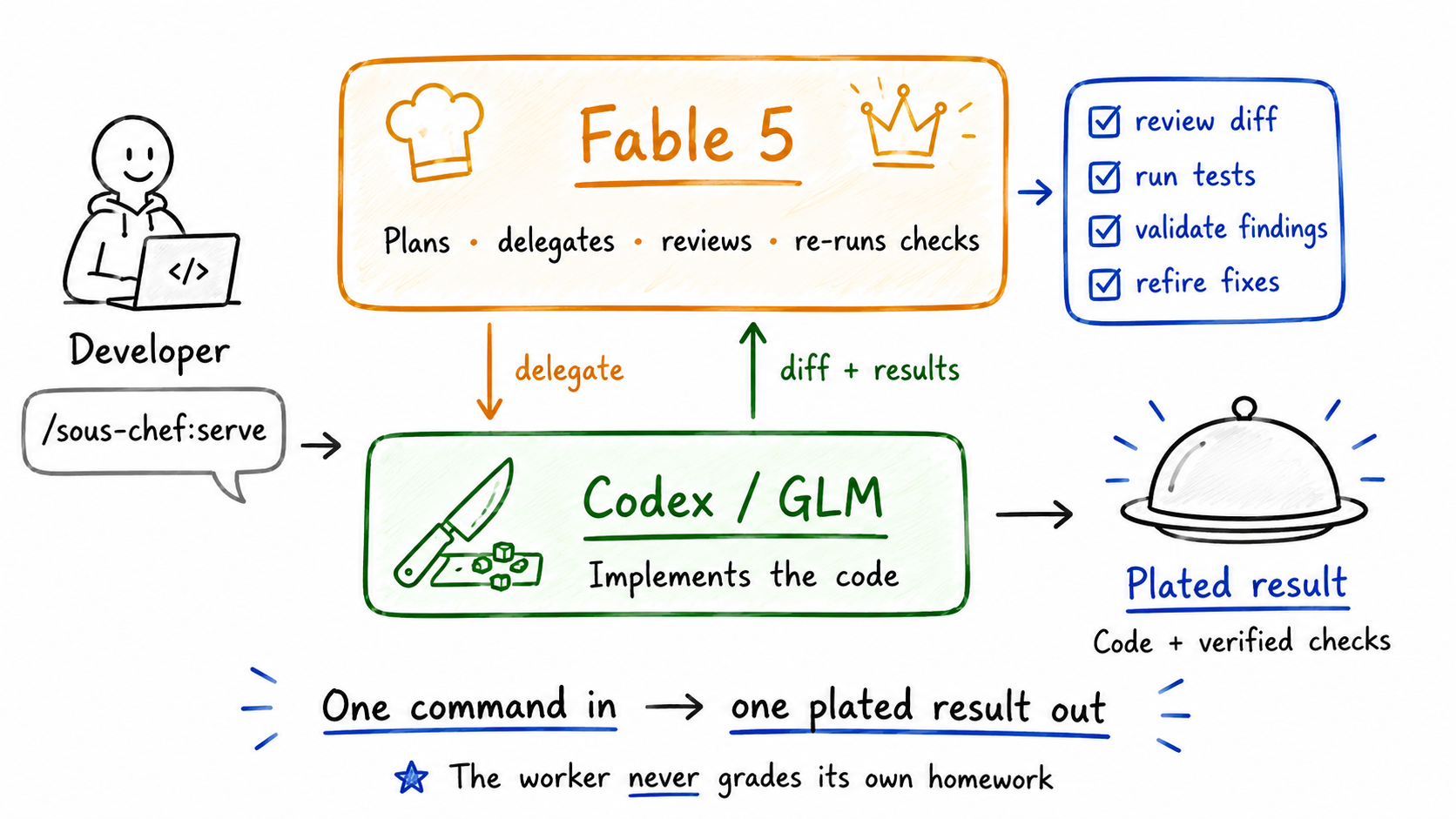
Codex saying "tests pass" is a sentence; pnpm test output is a fact - Claude
re-runs everything itself.
/sous-chef:serve is for task-shaped work, done end to end: implement,
cross-review, fix the findings, verify. One announcement up front, one report at the
end, a hard budget of five Codex runs in between. This is the daily driver.
/sous-chef:simmer is for goal-shaped work, looped until a command passes:
"make the suite green", "get the benchmark under 200ms". A fresh Codex run each lap,
Claude judging every lap with real command output, on a dedicated branch, with lap
caps and no-progress detection. The worker never grades its own homework.
Rule of thumb: serve a task, simmer a goal. If a serve runs out of budget and what remains is goal-shaped, it offers to continue as a simmer.
À la carte, when you want to drive the stations yourself:
| Command | What it does |
|---|---|
/sous-chef:fire | Write the ticket, delegate one implementation run, review the diff against a pre-fire baseline, verify. |
/sous-chef:taste | Cross-model review, read-only. Claude validates every finding against the code and filters false positives before you see them. |
/sous-chef:refire | Turn the confirmed findings from a taste into one scoped fix run, then re-verify each finding at its cited location. |
/sous-chef:mise | Setup: Codex CLI + auth checks, delegation profile, AGENTS.md scaffold, routing policy (manual or autonomous). Once per machine, once per repo. |
/sous-chef:receipts | Print the check: the repo's last ten run receipts as a table with a savings total; reprint any receipt's shareable summary. |
Requirements: Codex CLI ≥ 0.134,
authenticated (codex login - a ChatGPT subscription is enough; no API key needed).
/plugin marketplace add tomascupr/sous-chef
/plugin install sous-chef@sous-chef
(sous-chef@sous-chef is plugin@marketplace - same name for both here.) Then,
inside a repo:
/sous-chef:mise
/mise is idempotent - re-run it anytime as a health check, and after a plugin
update to refresh the installed profile.
you ── "/sous-chef:serve migrate auth" ──▶ CLAUDE (head chef)
                                              │ ticket: files ±, done-when,
                                              │ verification commands
                                              ▼
            ┌────────────────────────────────────────────┐
            │ codex exec --profile sous-chef             │  background;
            │ workspace-write sandbox · approvals off    │  no session memory;
            │ reads AGENTS.md · implements the ticket    │  hard boundary
            └───────────────────┬────────────────────────┘
                                ▼ diff
            CLAUDE reviews + re-runs verification itself
                                ▼
            CODEX reviews read-only, fresh context ──▶ CLAUDE validates findings
                                ▼
            confirmed findings refired once ──▶ verified ──▶ served
npx claudepluginhub tillda/sous-chefMemory compression system for Claude Code - persist context across sessions
 thedotmack
Unified capability management center for Skills, Agents, and Commands.
 guanyang
Ultra-compressed communication mode. Cuts 65% of output tokens (measured) while keeping full technical accuracy by speaking like a caveman.
 JuliusBrussee
Frontend design skill for UI/UX implementation
 anthropics
Marketing skills for AI agents — conversion optimization, copywriting, SEO, paid ads, ad creative, and growth
 coreyhaines31
Comprehensive UI/UX design plugin for mobile (iOS, Android, React Native) and web applications with design systems, accessibility, and modern patterns
 wshobson
'%20stop-opacity%3D'0.16'%2F%3E%3Cstop%20offset%3D'1'%20stop-color%3D'rgb(200%2C90%2C60)'%20stop-opacity%3D'0.03'%2F%3E%3C%2FlinearGradient%3E%3C%2Fdefs%3E%3Crect%20width%3D'320'%20height%3D'200'%20fill%3D'url(%23g)'%2F%3E%3Ccircle%20cx%3D'250'%20cy%3D'56'%20r%3D'92'%20fill%3D'rgb(200%2C90%2C60)'%20fill-opacity%3D'0.06'%2F%3E%3Ccircle%20cx%3D'64'%20cy%3D'172'%20r%3D'58'%20fill%3D'rgb(200%2C90%2C60)'%20fill-opacity%3D'0.05'%2F%3E%3C%2Fsvg%3E)
