Stats
Actions
Available In
Tags

Run custom Python scripts automatically in response to Claude Code events, enabling workflow automation and doctor diagnostics, while also integrating with the Nexo cryptocurrency platform for data access.
Matches all tools
Hooks run on every tool call, not just specific ones
Admin access level
Server config contains admin-level keywords
Own this plugin?
Verify ownership to unlock analytics, metadata editing, and a verified badge. GitHub access is read-only (username + org membership).
Sign in to claimOwn this plugin?
Verify ownership to unlock analytics, metadata editing, and a verified badge. GitHub access is read-only (username + org membership).
Sign in to claimBased on adoption, maintenance, documentation, and repository signals. Not a security audit or endorsement.
This plugin requires configuration values that are prompted when the plugin is enabled. Sensitive values are stored in your system keychain.
operator_nameWhat should your AI co-operator call itself? (default: Nova)
${user_config.operator_name}




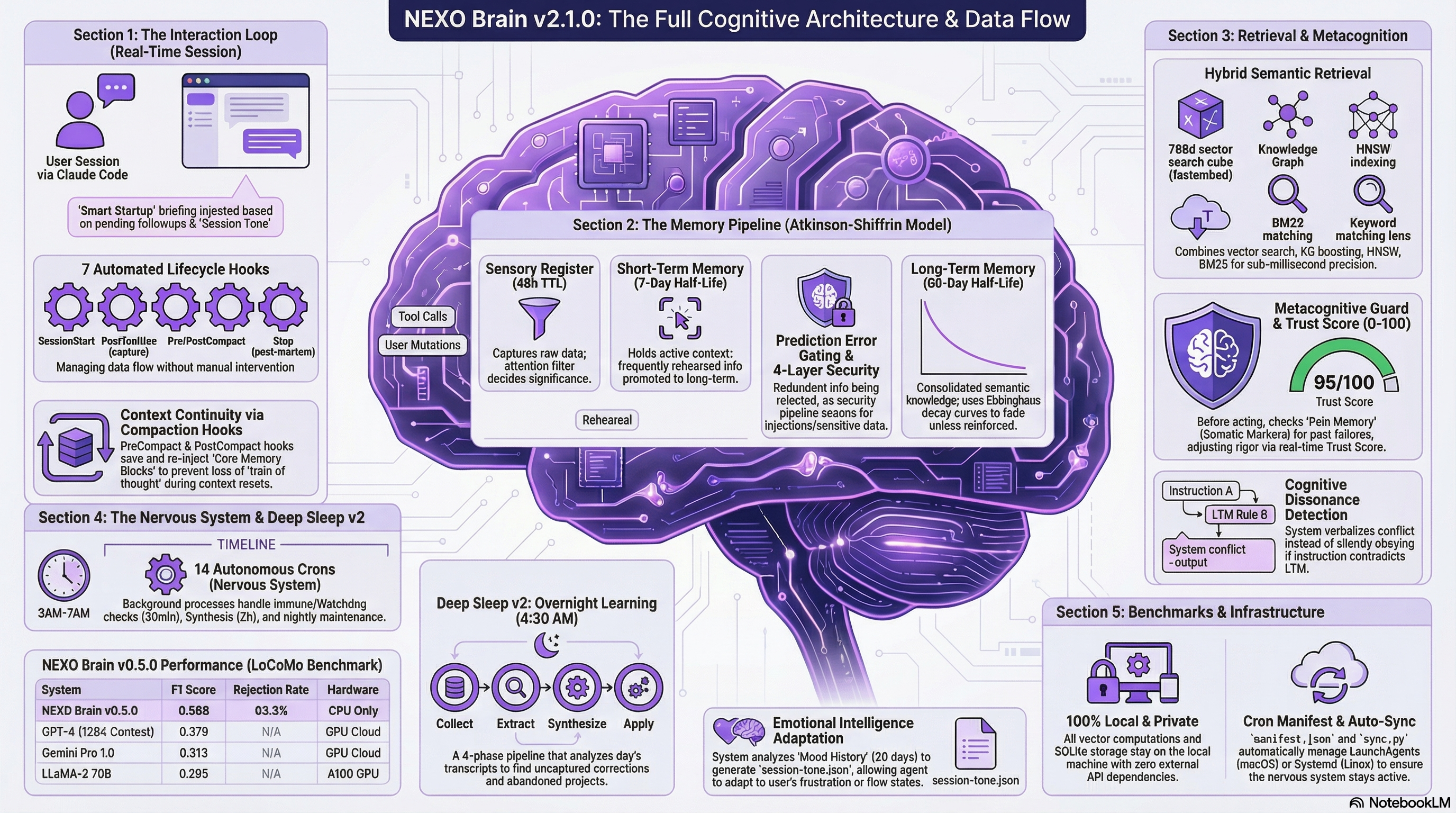
Local cognitive runtime with a shared brain across Claude Code, Codex, Claude Desktop, and other MCP clients. Persistent memory, durable workflow runs, selectable terminal and automation backends, overnight learning, self-healing background jobs, startup preflight, and doctor diagnostics. 150+ MCP tools. Benchmarked on LoCoMo (F1 0.588, +55% vs GPT-4).
NEXO Brain transforms any MCP-compatible AI agent from a stateless assistant into a cognitive partner that remembers, learns, forgets, adapts, and builds a relationship with you over time.
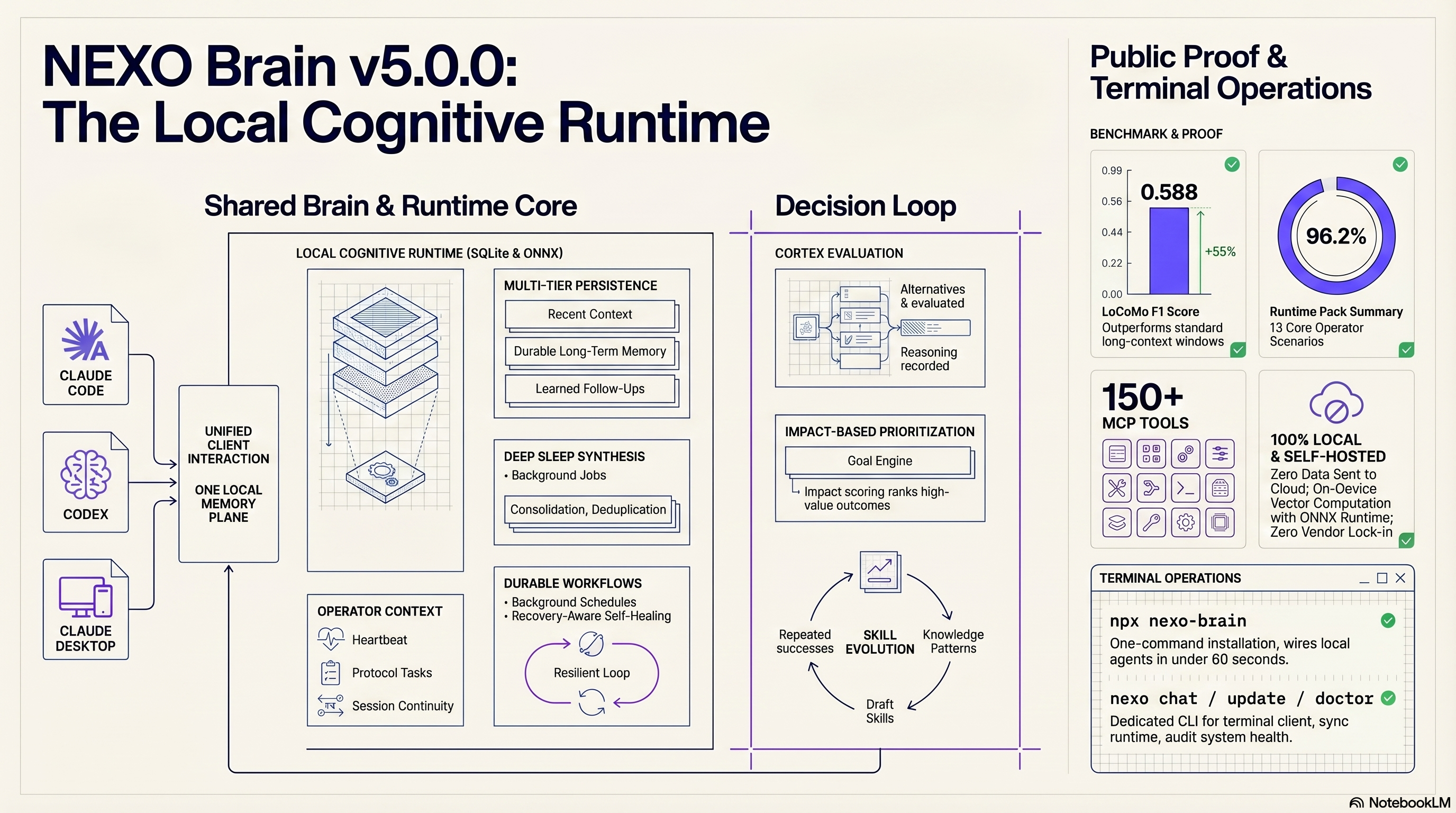
Watch the overview video · Watch on YouTube · Open the infographic
Version 7.38.0 is the current packaged-runtime line. Minor release over v7.37.4 - closeout integrity and operator-facing discipline: proactive status on long opaque work, per-item verified state on batch closeouts, decision-readable first responses, an automatic production change ledger across a wider mutation surface, new closure/evidence/cost-secret audit modules, and a correction-learning gate that never blocks mid-work. New behavioral rules ship in shadow/log mode by default.
Previously in 7.37.4: patch release over v7.37.3 - product-gap reporting, stale briefing noise, and opportunity loops: Deep Sleep reports recurring NEXO product gaps through sanitized Desktop support tickets, self-audit preserves closed internal opportunities, the morning briefing reads item history before resurfacing decisions, and support-ticket tools match the live backend contract.
Previously in 7.37.2: patch release over v7.37.1 - runtime shutdown and CI stability: session keepalive writers now stop before the shared SQLite connection closes, SQLite close is serialized under the write lock, and the full Brain test workflow has enough time to finish instead of cancelling slow-but-valid runs. The v7.37.2 tag attempt did not publish npm/GitHub release artifacts; v7.37.3 is the public line.
Previously in 7.37.1: patch release over v7.37.0 - release hardening for Desktop-bundled Brain: large existing local-context.db files no longer run a surprise full VACUUM on the first writer, schema_abstraction MCP tools are loaded by the essential startup set, and learning tools tolerate Desktop compatibility payloads. Builds on v7.37.0 (transparent server self-heal + email zombie reinjection guard).
Previously in 7.31.9: patch release over v7.31.8 - UI release closeout now has to prove the original reported symptom was reopened with observable evidence before claiming the release is ready.
Previously in 7.31.8: patch release over v7.31.7 - email monitor debt scans no longer escalate intentionally waiting threads as unresolved commitments when recent resolution or hot-context state proves the thread is waiting on the user or a third party. Real unresolved commitments still surface.
Previously in 7.31.7: patch release over v7.31.6 - stateful answers now require evidence before claiming release, commit, branch, server, ticket, deployment, sent/uploaded, installed, verified, or closed status. Guardian defaults promote identity coherence to hard/core and add a hard/core pre-answer evidence gate, while closeout and Local Context telemetry now leave stronger proof trails.
Previously in 7.31.6: patch release over v7.31.5 - headless/email-monitor notifications now respect the Desktop UI language for static ES/EN templates before falling back to profile/calibration language and English.
Previously in 7.31.5: patch release over v7.31.4 - the breaker resume notice exists: when a notified engine pause recovers, the operator gets exactly one resume email in their language, signed by their agent.
Previously in 7.31.4: patch release over v7.31.3 - memory recall honours absolute time ranges (ISO dates, start..end ranges, datetimes, epochs) and enforces the window in SQL, so asking about a specific past day returns that day.
npx claudepluginhub wazionapps/nexoNemp Memory — Cognitive memory layer for AI agents across every platform. Local-first, zero cloud, works with Claude, Codex, Cursor, and Windsurf.
 SukinShetty
Stateful agent tools for Claude Code. Learns who you are, remembers what you're working on, schedules tasks, maintains itself.
 ascorbic
Persistent memory for Claude Code — remembers across sessions automatically. Install and forget. Scientific retrieval backed by 72 published references.
 cdeust
Long-term semantic memory for Claude Code, powered by OpenViking. Auto-recall relevant memories at session start and capture important information during conversations.
 Castor6
Reflex-based memory system for AI agents — stores experiences as interconnected neurons and recalls them through spreading activation, mimicking how the human brain works.
 nhadaututtheky
Agent-First symbiotic cognitive substrate. 20 fungal-named verbs (germinate / hunger / eat / sense / forage / excrete / intake / assimilate / digest / sporulate / traverse / propagate / immune / senesce / fruit / molt / winnow / ramify / graft / brief). 47-dimension immune across 7 subsystems (germination / ingestion / digestion / circulation / homeostasis / cycle / boundary). Schema v3 canon, MCP capability surface (tools, prompts, sampling, progress, logging) with stdio + streamable-http + OAuth 2.1 transports. Editable-by-default install, substrate-local plugin loading via .myco/plugins/, 10 automated MCP host writers via data-driven JsonClientSpec table.
 Battam1111
'%20stop-opacity%3D'0.16'%2F%3E%3Cstop%20offset%3D'1'%20stop-color%3D'rgb(200%2C90%2C60)'%20stop-opacity%3D'0.03'%2F%3E%3C%2FlinearGradient%3E%3C%2Fdefs%3E%3Crect%20width%3D'320'%20height%3D'200'%20fill%3D'url(%23g)'%2F%3E%3Ccircle%20cx%3D'250'%20cy%3D'56'%20r%3D'92'%20fill%3D'rgb(200%2C90%2C60)'%20fill-opacity%3D'0.06'%2F%3E%3Ccircle%20cx%3D'64'%20cy%3D'172'%20r%3D'58'%20fill%3D'rgb(200%2C90%2C60)'%20fill-opacity%3D'0.05'%2F%3E%3C%2Fsvg%3E)