Stats
Actions
Available In
Tags

Substrate plugin for Ruflo memory: AgentDB controller bridge (15 agentdb_* MCP tools), RuVector ONNX embeddings (10 embeddings_* tools incl. RaBitQ 32x quantization), and WASM HNSW pattern router (3 ruvllm_hnsw_* tools)
Query AgentDB through the controller bridge -- semantic routing, hierarchical recall, causal graphs, context synthesis, pattern store/search
Vector search via embeddings_* (large-scale HNSW) and ruvllm_hnsw_* (WASM router for ≤11 hot patterns), with RaBitQ 1-bit quantization for 32× memory reduction
Uses power tools
Uses Bash, Write, or Edit tools
Own this plugin?
Verify ownership to unlock analytics, metadata editing, and a verified badge. GitHub access is read-only (username + org membership).
Sign in to claimOwn this plugin?
Verify ownership to unlock analytics, metadata editing, and a verified badge. GitHub access is read-only (username + org membership).
Sign in to claimBased on adoption, maintenance, documentation, and repository signals. Not a security audit or endorsement.





Multi-agent AI orchestration for Claude Code
Orchestrate 100+ specialized AI agents across machines, teams, and trust boundaries. Ruflo adds coordinated swarms, self-learning memory, federated comms, and enterprise security to Claude Code — so agents don't just run, they collaborate.
Claude Flow is now Ruflo — named by rUv, who loves Rust, flow states, and building things that feel inevitable. The "Ru" is the Ruv. The "flo" is the flow. Underneath, WASM kernels written in Rust power the policy engine, embeddings, and proof system.
One init gives Claude Code a nervous system: agents self-organize into swarms, learn from every task, remember across sessions, and — with federation — securely talk to agents on other machines without leaking data. You keep writing code. Ruflo handles the coordination.
Self-Learning / Self-Optimizing Agent Architecture

User --> Ruflo (CLI/MCP) --> Router --> Swarm --> Agents --> Memory --> LLM Providers
                          ^                           |
                          +---- Learning Loop <-------+
New to Ruflo? You don't need to learn 314 MCP tools or 26 CLI commands. After
init, just use Claude Code normally -- the hooks system automatically routes tasks, learns from successful patterns, and coordinates agents in the background.
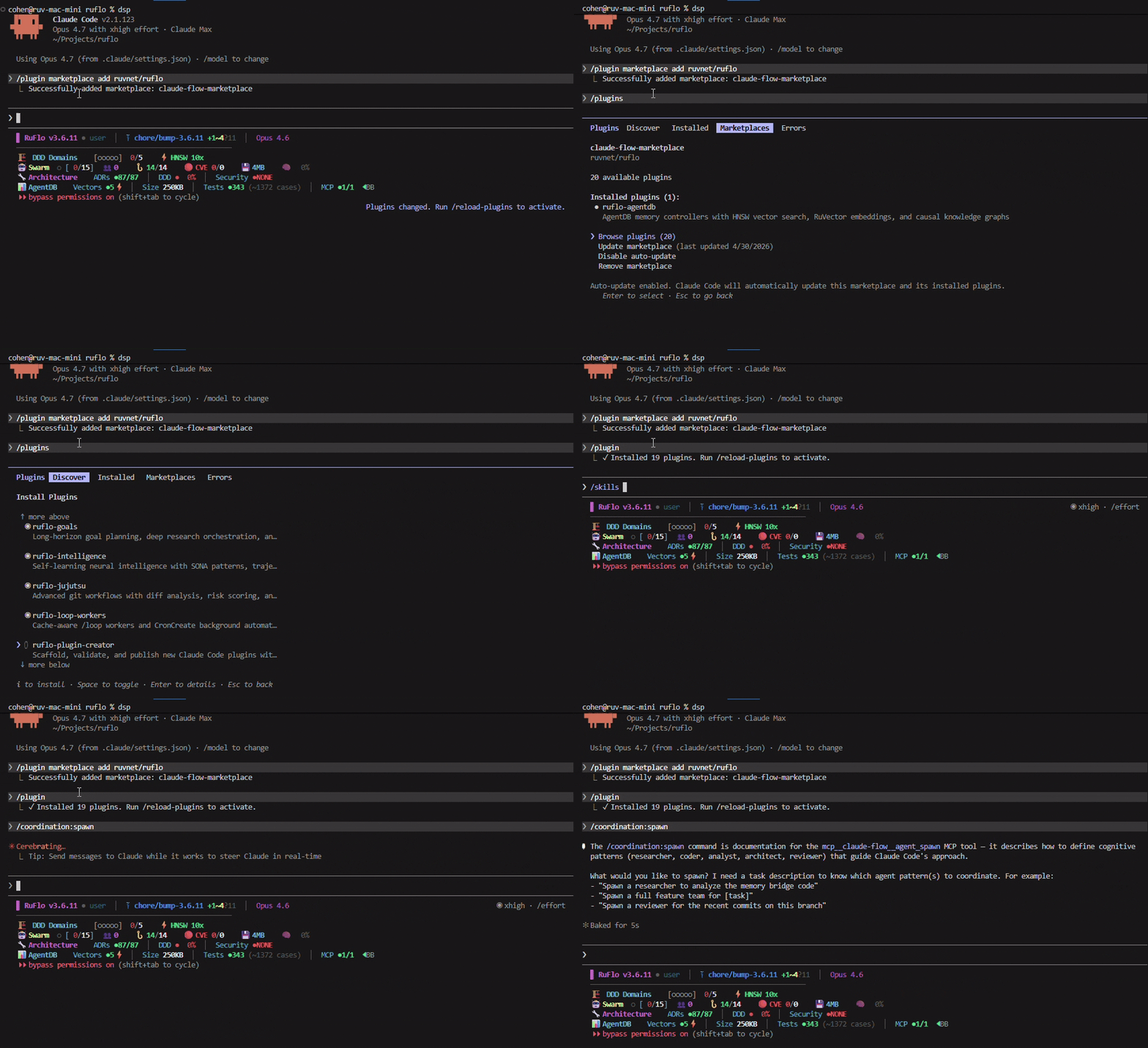
There are two different install paths with very different surface areas. Pick based on what you need (#1744):
| Claude Code Plugin | CLI install (npx ruflo init) | |
|---|---|---|
| What it gives you | Slash commands + a few skills + agent definitions per-plugin | Full Ruflo loop — 98 agents, 60+ commands, 30 skills, MCP server, hooks, daemon |
| Files in your workspace | Zero | .claude/, .claude-flow/, CLAUDE.md, helpers, settings |
| MCP server registered | No (memory_store, swarm_init, etc. unavailable to Claude) | Yes |
| Hooks installed | No | Yes |
| Best for | Try a single plugin's commands without committing to the full install | Production use — everything works as documented |
# Add the marketplace
/plugin marketplace add ruvnet/ruflo

# Install core + any plugins you need
/plugin install ruflo-core@ruflo
/plugin install ruflo-swarm@ruflo
/plugin install ruflo-autopilot@ruflo
/plugin install ruflo-federation@ruflo
This adds slash commands and agent definitions only. The Ruflo MCP server is NOT registered, so memory_store, swarm_init, agent_spawn, etc. won't be callable from Claude. For the full loop, use Path B below.
| Plugin | What it does |
|---|---|
| ruflo-core | Foundation — server, health checks, plugin discovery |
| ruflo-swarm | Coordinate multiple agents as a team |
| ruflo-autopilot | Let agents run autonomously in a loop |
| ruflo-loop-workers | Schedule background tasks on a timer |
| ruflo-workflows | Reusable multi-step task templates |
| ruflo-federation | Agents on different machines collaborate securely |
| Plugin | What it does |
|---|---|
| ruflo-agentdb | Fast vector database for agent memory |
| ruflo-rag-memory | Smart retrieval — hybrid search, graph hops, diversity ranking |
| ruflo-rvf | Save and restore agent memory across sessions |
| ruflo-ruvector | ruvector — GPU-accelerated search, Graph RAG, 103 tools |
| ruflo-knowledge-graph | Build and traverse entity relationship maps |
npx claudepluginhub zekiog/ruflo --plugin ruflo-agentdbCross-installation agent federation with zero-trust security, peer discovery, consensus-based task routing, and per-call budget circuit breaker (ADR-097)
 Zekiog
RuVector memory with HNSW search, AgentDB, and semantic retrieval
ZekiogIoT device lifecycle, telemetry anomaly detection, fleet management, and witness chain verification for Cognitum Seed hardware
ZekiogNeural trading via npx neural-trader — self-learning strategies, Rust/NAPI backtesting, 112+ MCP tools, swarm coordination, and portfolio optimization
ZekiogTest gap detection, coverage analysis, and automated test generation — drives the testgaps background worker via hooks_worker-dispatch; SPARC Refinement-phase canonical owner
ZekiogIntelligent draw.io diagramming plugin with AI-powered diagram generation, multi-platform embedding (GitHub, Confluence, Azure DevOps, Notion, Teams, Harness), conditional formatting, live data binding, and MCP server integration for programmatic diagram creation and management.
 markus41
Persistent file-based planning for AI coding agents. Crash-proof markdown plans (task_plan.md, findings.md, progress.md) that survive context loss and /clear, with an opt-in completion gate and multi-agent shared state. Manus-style. Works with Claude Code, Codex CLI, Cursor, Kiro, OpenCode and 60+ agents via the SKILL.md standard. Includes Arabic, German, Spanish, and Chinese (Simplified and Traditional).
 OthmanAdi
Harness-native ECC plugin for engineering teams - 67 agents, 271 skills, 92 legacy command shims, reusable hooks, rules, MCP conventions, and operator workflows for Claude Code plus adjacent agent harnesses
 affaan-m
v9.44.1 — Patch release for Gemini environment/version detection and qwen auth gating. Run /octo:setup.
 nyldn
nyldnSuperpowers Plus core skills library for Claude Code: planning, execution routing, TDD, debugging, and collaboration workflows
 xhyqaq
Complete creative writing suite with 10 specialized agents covering the full writing process: research gathering, character development, story architecture, world-building, dialogue coaching, editing/review, outlining, content strategy, believability auditing, and prose style/voice analysis. Includes genre-specific guides, templates, and quality checklists.
 greyhaven-ai
'%20stop-opacity%3D'0.16'%2F%3E%3Cstop%20offset%3D'1'%20stop-color%3D'rgb(200%2C90%2C60)'%20stop-opacity%3D'0.03'%2F%3E%3C%2FlinearGradient%3E%3C%2Fdefs%3E%3Crect%20width%3D'320'%20height%3D'200'%20fill%3D'url(%23g)'%2F%3E%3Ccircle%20cx%3D'250'%20cy%3D'56'%20r%3D'92'%20fill%3D'rgb(200%2C90%2C60)'%20fill-opacity%3D'0.06'%2F%3E%3Ccircle%20cx%3D'64'%20cy%3D'172'%20r%3D'58'%20fill%3D'rgb(200%2C90%2C60)'%20fill-opacity%3D'0.05'%2F%3E%3C%2Fsvg%3E)

