Stats
Actions
Available In
Tags

Enforce architectural rules, clean code, DDD, security, and test quality across the software delivery lifecycle using composable AI skills that guide design, code generation, review, and documentation workflows.
Enforce architectural rules when generating or modifying code. Defaults to clean architecture; supports any architecture style via the architecture-refiner. Validates layer responsibilities, dependency direction, and structural constraints using the loaded architecture rules. Use when generating code, reviewing architecture, creating new files, or when the user mentions 'architecture', 'layers', 'structure', 'dependency rules', 'hexagonal architecture', 'ports and adapters', 'modular monolith', or 'onion architecture'. Also use when reviewing generated code for structural compliance.
Apply clean code principles when generating or modifying implementation code. Enforces function focus, naming clarity, complexity management, error handling, and self-documenting style. Use during code generation, refactoring, or when the user mentions 'clean code', 'code quality', 'refactor this', 'simplify this', 'improve this', 'make this cleaner', 'clean this up', 'tidy this', 'coding guidelines', or 'implementation quality'. This skill governs the craft of writing individual code units -- not architecture (see architecture), not security posture (see secure-coding), and not test structure (see test-quality).
Protocol for handling ambiguous decisions and missing/conflicting knowledge during code generation, design, and review. Ensures AI surfaces genuine judgment calls with structured options and stops on hallucination risk instead of silently assuming. Use when a decision has multiple valid approaches, when facts are missing or contradictory, when the user asks 'what should we do here?', 'is this a judgment call?', 'should I ask about this?', 'am I guessing here?', 'what are the tradeoffs?', or when deciding between two reasonable architectural or design options. Also composed by molecules to define how judgment calls and clarification requests are surfaced and resolved.
Manage per-feature living documents that capture decisions, constraints, and reasoning across AI sessions during active development. Scoped to feature-level work — design, implementation, bugfix, refactor — not for codebase-wide assessments or product-wide specifications (those define their own document lifecycles). Handles creating new context documents, loading existing ones, and enriching them with new decisions. Use when starting a new feature, resuming work, making technical decisions, resolving questions, or when context needs to persist across sessions. Use this skill whenever the user mentions 'load context', 'update context', 'context doc', 'decisions', 'continue where we left off', 'what did we decide', or 'capture this decision'.
Guide structured design thinking through 5 progressive levels before any code is written. Levels: Capabilities, Components, Interactions, Contracts, Implementation. Use when building new features, refactoring significant code, designing modules, or when the user says 'design this', 'architect this', 'let's think before coding', 'walk me through the design', or 'whiteboard this'. For simple utilities or single-component tasks, enter at Level 4 (Contracts). Do not use for quick bug patches.
Own this plugin?
Verify ownership to unlock analytics, metadata editing, and a verified badge. GitHub access is read-only (username + org membership).
Sign in to claimOwn this plugin?
Verify ownership to unlock analytics, metadata editing, and a verified badge. GitHub access is read-only (username + org membership).
Sign in to claimBased on adoption, maintenance, documentation, and repository signals. Not a security audit or endorsement.
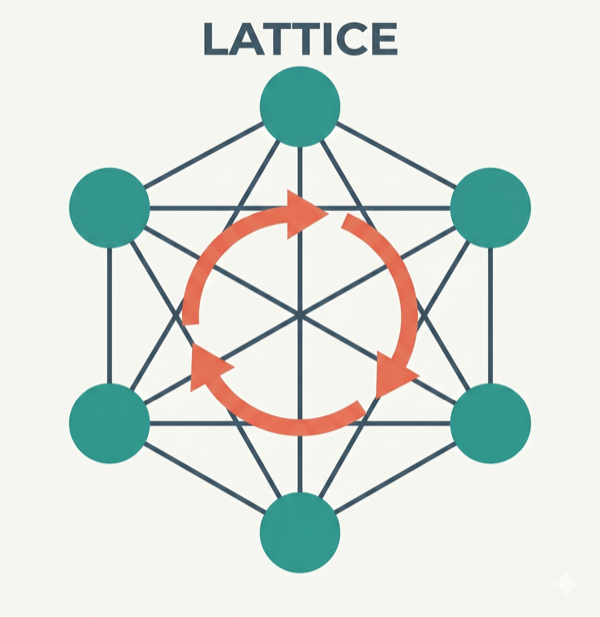
Composable AI skills that teach assistants structured thinking — design-first, context-aware, and architecture-guided.





AI coding assistants jump straight to code, silently make design decisions, forget constraints mid-conversation, and produce output nobody reviewed against real standards. Lattice fixes this with composable skills in three tiers — atoms, molecules, refiners — that embed battle-tested engineering disciplines plus a living context layer that accumulates your project's standards, decisions, and review insights across every feature cycle.
Three principles guided Lattice's design:
.lattice/ folder grows smarter with every feature cycle rather than being configured once and forgotten| Tier | Purpose |
|---|---|
| Atoms | Single-principle guardrails — clean code, architecture, DDD, secure coding, test quality, design-first, and more |
| Molecules | Multi-step workflows that compose atoms — design, implement, refactor, fix, review |
| Refiners | Guided interviews that produce project-specific standards, customizing how atoms behave for your team |
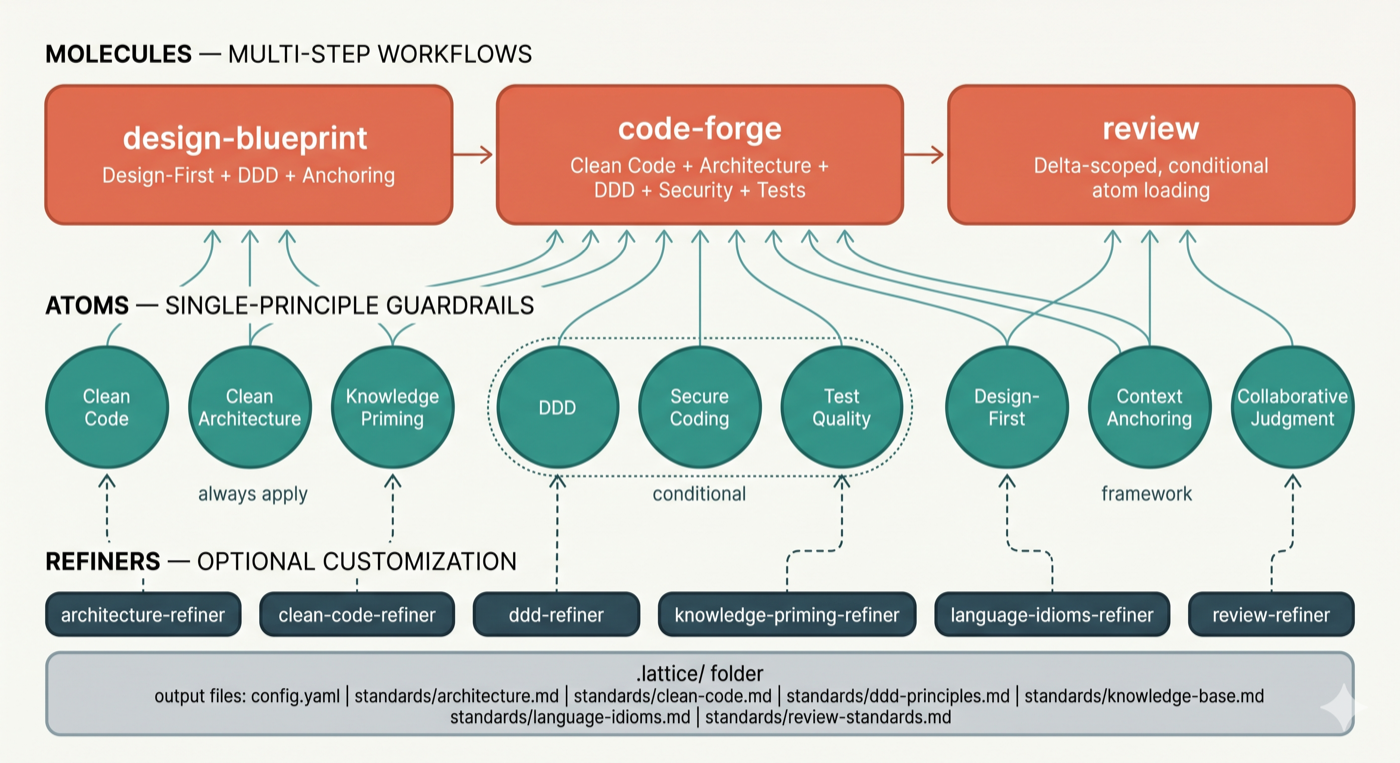
See How It Works for the full skill inventory and mechanics.
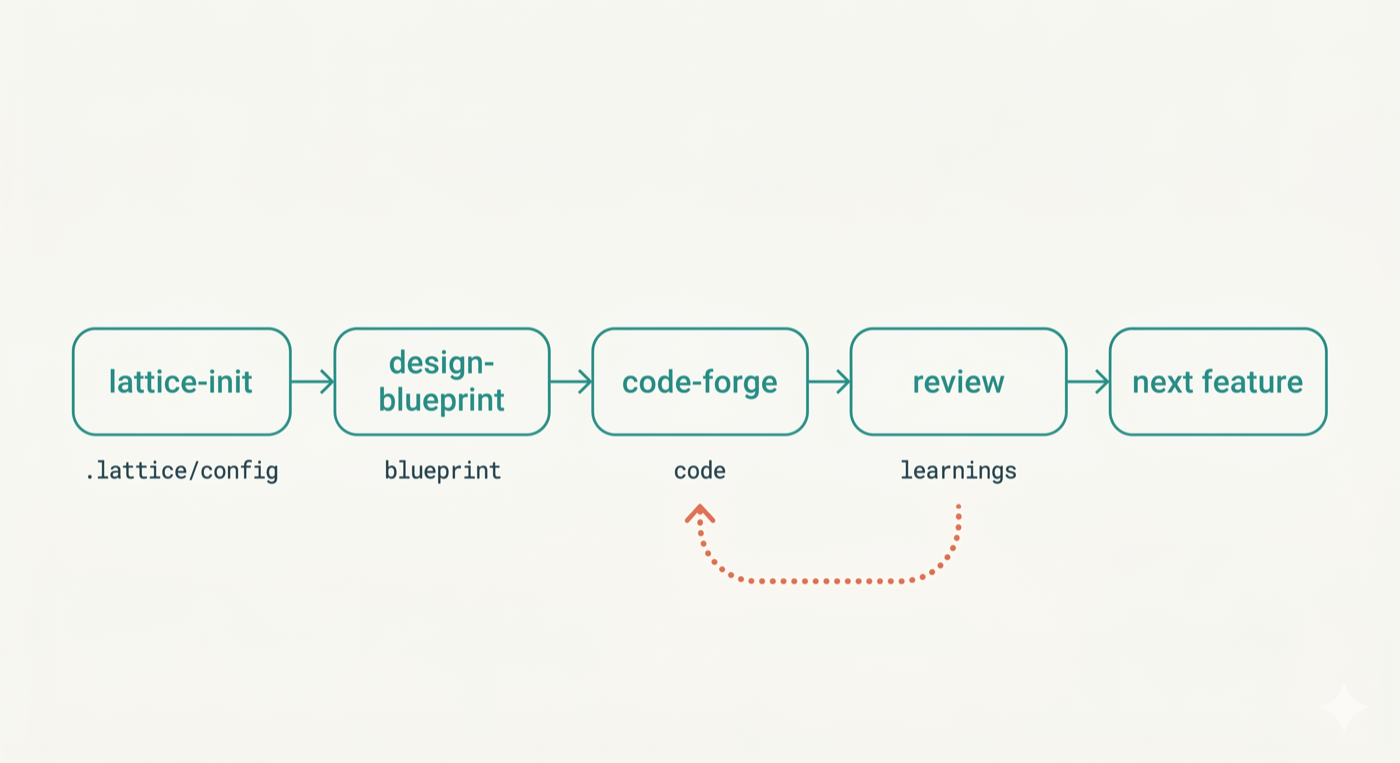
Skills form a delivery lifecycle: requirement-forge → design-blueprint → code-forge → review, with refactor-safely and bug-fix covering structural and defect-driven work. requirement-forge starts the pipeline — it acts as a senior PM + BA pair to produce structured feature specs in .lattice/requirements/ that feed directly into design-blueprint. For teams with existing codebases, architecture-compass sits before the pipeline — it scans the repository, runs a structured interview, and produces an agreed architectural direction that orients the team before any code changes begin. Each stage consumes and produces artifacts in .lattice/, growing the living context layer.
Install Lattice — choose the path that fits your setup:
Option A — Claude Code plugin (also works in Cursor — reads Claude Code skills automatically)
/plugins marketplace add techygarg/lattice
/plugins install lattice
/reload-plugins
Option B — Codex-compatible plugin package
codex plugin marketplace add techygarg/lattice
codex plugin add lattice@lattice
codex plugin list | rg -i lattice
The Codex plugin package lives in plugins/lattice/ and is registered by .agents/plugins/marketplace.json. It contains the same 26 skills flattened for Codex discovery.
This duplication currently to support codex. In future, we may find a better approach as tools evolves.
Option C — Clone and install locally (any AI tool)
git clone https://github.com/techygarg/lattice.git
cd lattice
./tools/install.sh /absolute/path/to/your/skills/folder
Pass the skills directory for your tool: ~/.claude/skills/ for Claude Code, .cursor/skills/ for Cursor, or any tool's skills folder.
Try it immediately. The repo includes
sample/— a realistic .NET 8 User Service spec with requirements, domain concepts, and constraints already written. Copy thesample/folder contents into any empty directory and follow the steps below.
Run /lattice-init in your AI tool's chat — scans the project, suggests refiners in priority order, creates .lattice/config.yaml. All skill commands (/lattice-init,/requirement-forge, /design-blueprint, /code-forge, etc.) are typed in the AI chat, not the terminal.
npx claudepluginhub techygarg/lattice --plugin latticeVerification-first engineering toolkit for Claude Code. 15 skills across a 5-phase spine (Investigate → Design → Implement → Verify → Ship), 8 specialist agents, an interactive setup wizard. Every skill has rationalizations + evidence requirements. Built for senior ICs and tech leads.
 duthaho
19 software engineering skills from Code Complete, APOSD, GoF, and Clean Architecture. Skills are internal (slash-invocable; injected via Read() — not auto-triggered). Research → plan → build workflow with Gate-field adaptive gates (Full | Standard | Minimal) and per-phase orchestrated commits.
 ryanthedev
Production-grade engineering skills for AI coding agents — covering the full software development lifecycle from spec to ship.
 addyosmani
Harness for Claude Code — skills, /harness:* slash commands, persona subagents, lifecycle hooks, and MCP tools without per-repo `harness setup`. Sibling plugins exist for Cursor, Gemini CLI, and Codex.
 Intense-Visions
Plugin de ingeniería de software completa: 10 agentes de núcleo y 9 opcionales con personalidad propia, memoria persistente por proyecto, quality gates y flujos automatizados desde la idea hasta producción.
 686f6c61
Architecture analysis, brainstorming, ADR generation, LLM-as-judge comparison, and spec gap resolution.
 existential-birds
'%20stop-opacity%3D'0.16'%2F%3E%3Cstop%20offset%3D'1'%20stop-color%3D'rgb(200%2C90%2C60)'%20stop-opacity%3D'0.03'%2F%3E%3C%2FlinearGradient%3E%3C%2Fdefs%3E%3Crect%20width%3D'320'%20height%3D'200'%20fill%3D'url(%23g)'%2F%3E%3Ccircle%20cx%3D'250'%20cy%3D'56'%20r%3D'92'%20fill%3D'rgb(200%2C90%2C60)'%20fill-opacity%3D'0.06'%2F%3E%3Ccircle%20cx%3D'64'%20cy%3D'172'%20r%3D'58'%20fill%3D'rgb(200%2C90%2C60)'%20fill-opacity%3D'0.05'%2F%3E%3C%2Fsvg%3E)